Alexander V. Gheorghiu Tao Gu David J. Pym
Proof-theoretic semantics (P-tS) is an innovative approach to grounding logical meaning in terms of proofs rather than traditional truth-conditional semantics. The point is not that one provides a proof system, but rather that one articulates meaning in terms of proofs and provability. To elucidate this paradigm shift, we commence with an introduction that contrasts the fundamental tenets of P-tS with the more prevalent modeltheoretic approach to semantics. The contribution of this paper is a P-tS for a substructural logic, intuitionistic multiplicative linear logic (IMLL). Specifically, we meticulously examine and refine the established P-tS for intuitionistic propositional logic. Subsequently, we present two novel and comprehensive forms of P-tS for IMLL. Notably, the semantics for IMLL in this paper embodies its resource interpretation through its number-of-uses reading (restricted to atoms). This stands in contrast to the conventional model-theoretic semantics of the logic, underscoring the value that P-tS brings to substructural logics.
1 Introduction
In model-theoretic semantics (M-tS), logical consequence is defined in terms of models; that is, abstract mathematical structures in which propositions are interpreted and their truth is judged. In the standard reading given by Tarski [57,58], a propositional formula $\phi$ follows model-theoretically from a context $\Gamma$ iff every model of $\Gamma$ is a model of $\phi$; that is, $\Gamma \models \phi$ iff for all models $M$, if $M \models \psi$ for all $\psi \in \Gamma$, then $M \models \phi$. In this setup, meaning and validity are characterized in terms of truth.
Proof-theoretic semantics (P-tS) [12,49,60] is an alternative approach to meaning and validity in which they are characterized in terms of proofs— understood as objects denoting collections of acceptable inferences from accepted premisses. To be clear, P-tS is not about providing a proof system, but rather about expressing the meaning and validity in terms of proofs and provability. Schroeder-Heister [50] observes, since no formal system is fixed (only notions of inference) the relationship between semantics and provability remains the same as it has always been: soundness and completeness are desirable features of formal systems. The semantic paradigm supporting P-tS is inferentialism—the view that meaning (or validity) arises from rules of inference (see Brandom [6]).
Heuristically, what differs is that proofs in P-tS serve the role of truth in M-tS. This shift has substantial and subtle mathematical and conceptional consequences, as discussed below. Importantly, ‘proof’ here refers to a prelogical notion of valid argument, not proof in a formal system.
To illustrate the paradigmatic shift from M-tS to P-tS, consider the proposition “Tammy is a vixen”. What does it mean? Intuitively, it means, somehow, “Tammy is female” and “Tammy is a fox”. On inferentialism, its meaning is given by the rules, Tammy is a fox Tammy is female Tammy is a vixen Tammy is a vixen Tammy is female Tammy is a vixen Tammy is a fox These merit comparison with the laws governing $\land$ in IPL, which justify the sense in which the above proposition is a conjunction, $\phi, \psi \vdash \phi \land \psi$; $\phi \land \psi \vdash \phi$; $\phi \land \psi \vdash \psi$ There are several branches of research within P-tS—see, for example, the discussion on proof-theoretic validity in the Dummett–Prawitz tradition by Schroeder-Heister [52]. This paper is concerned with a formalism called baseextension semantics, following in the tradition of Sandqvist [46–48].
In general, a B-eS is determined by a judgement called support defined inductively according to the structure of formulae with the base case (i.e., the support of atoms) given by proof in a base (a collection of inference rules over atoms—see below); this is analogous to satisfaction in M-tS, with the base case given by truth at a world. Though this approach is closely related to possible-worlds semantics in the sense of Beth [3] and Kripke [27]—see, for example, Goldfarb [19], Makinson [34], and Stafford and Nascimento [55]— it remains subtle. For example, there are several incompleteness results for intuitionistic logics—see, for example, Piecha et al. [39–41], Goldfarb [19], Sandqvist [45–48], Stafford [54].
Significantly, a sound and complete B-eS for IPL has been given by Sandqvist [48]. This is the point of departure for this paper:
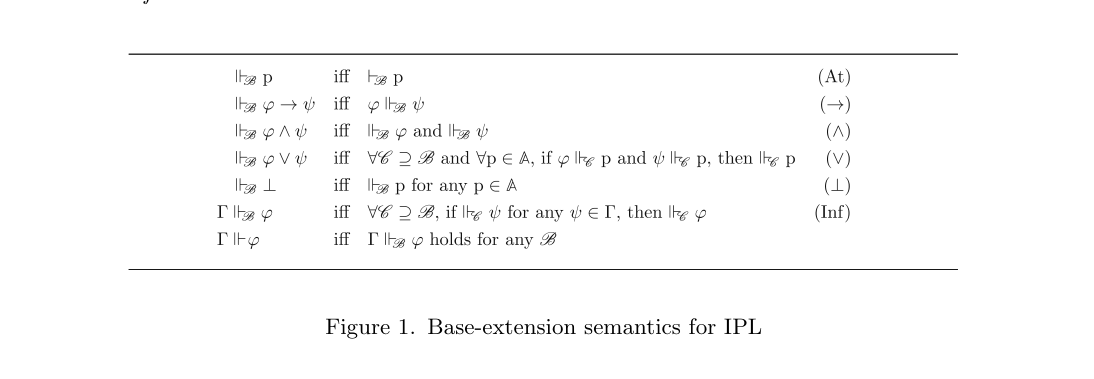
– Given a base B, we write $\vdash_{B} p$ to denote that $p \in A$ can be derived in $B$—defined in Section 2.
– Support in a base B—denoted $\forces_{B}$—is defined by the clauses of Figure 1 in which $\Gamma = \emptyset$. We desire to give an analogous semantics for intuitionistic multiplicative linear logic (IMLL). We study this logic as it is the minimal setting in which we can explore how to set up B-eS (and P-tS in general) for substructural logics, which enables extension to, for example, (intuitionistic) Linear Logic [18] and the logic of Bunched Implications [36]. Again, the aim is not simply to give a proof-theoretic interpretation of IMLL, which already exist, but to give a proof-theoretic semantics.
A compelling reading of IMLL is its ‘number-of-uses’ resource interpretation, which is inherently proof-theoretic—see, for example, [1,18,22,28]. Accordingly, looking at (Inf), we expect that $\phi$ being supported in a base B relative to some multiset of formulae $\Gamma$ means that the ‘resources’ garnered by $\Gamma$ suffice to produce $\phi.$ In this paper, we express this by enriching the notion of support with multisets of resources P and U combined with multiset union—denoted , . Then, that the resources garnered by $\Gamma$ are given to $\phi$ is captured by the following property: $$\Gamma \forces_{B}^{P} \phi \quad\text{iff}\quad \text{for any } X \supseteq B \text{ and any } U,\ \text{if } \forces_{X}^{U} \Gamma,\ \text{then } \forces_{X}^{P,U} \phi$$ The present authors have explored further IMLL’s resource interpretation in the setting of P-tS in [13]. Naively, we may define $\otimes$ as a resource-sensitive version of $(\land)$; that is, $$\forces_{B}^{P} \phi \otimes \psi \quad\text{iff}\quad \text{there are } P_1, P_2 \text{ s.t. } P = (P_1, P_2),\ \forces_{B}^{P_1} \phi,\ \text{and } \forces_{B}^{P_2} \psi$$ While the resulting semantics is sound, proving completeness is more subtle. We aim to follow the method by Sandqvist [46], and this clause is not suitable because the following is not the case for IMLL: $$\Gamma \vdash \phi \otimes \psi \quad\text{iff}\quad \text{there are } \Delta_1, \Delta_2 \text{ s.t. } \Gamma = (\Delta_1, \Delta_2),\ \Delta_1 \vdash \phi,\ \text{and } \Delta_2 \vdash \psi \tag{$\dagger$}$$ —a counter-example is the case where $\Gamma$ is the (singleton) multiset consisting of $\phi \otimes \psi$, which denies any non-trivial partition into smaller multisets. We employ, therefore, a more complex clause, which is inspired by the treatment of disjunction in IPL, that enables us to prove completeness using the approach by Sandqvist [48].
There is an obvious difference between the B-eS for IPL and its standard possible-worlds semantics in the sense of Kripke [27]—namely, the treatment of disjunction $(\lor)$ and absurdity $(\bot)$. The possible-worlds semantics has the clause, $$\mathfrak{M}, x \forces \phi \lor \psi \quad\text{iff}\quad \mathfrak{M}, x \forces \phi \text{ or } \mathfrak{M}, x \forces \psi$$ If such a clause is taken in the definition of validity in a B-eS for IPL, it leads to incompleteness—see, for example, Piecha and Schroeder-Heister [39,40]. To yield completeness, Sandqvist [46] uses a more complex form that is close to the elimination rule for disjunction in natural deduction (see Gentzen [56] and Prawitz [42])—that is, $$\forces_{B} \phi \lor \psi \quad\text{iff}\quad \text{for any } C \text{ such that } B \subseteq C \text{ and any } p \in A,\ \text{if } \phi \forces_{C} p \text{ and } \psi \forces_{C} p, \text{ then } \forces_{C} p$$ One justification for the clauses is the principle of definitional reflection (DR) (see Halln¨as [20,21] and Schroeder-Heister [51]): whatever follows from all the defining conditions of an assertion also follows from the assertion itself Taking the perspective that the introduction rules are definitions, DR provides an answer for the way in which the elimination rules follow. Similarly, it justifies that the clauses for the logical constants take the form of their elimination rules.
Why does the clause for conjunction $(\land)$ not take the form given by DR? What DR gives is the generalized elimination rule, $$\dfrac{\phi \land \psi \qquad \overset{\textstyle [\phi, \psi]}{\vdots} \quad \chi}{\chi}$$ We may modify the B-eS for IPL by replacing $(\land)$ with the following: $$\forces_{B} \phi \land \psi \quad\text{iff}\quad \text{for any } C \supseteq B \text{ and any } p \in A,\ \text{if } \phi, \psi \forces_{C} p, \text{ then } \forces_{C} p \tag{$\land'$}$$ We show in Section 2.3 that the result does indeed characterize IPL. Indeed, it is easy to see that the generalized elimination rule and the usual elimination rule for $\land$ have the same expressive power.
Note, we here take the definitional view of the introduction rules for the logical constants of IPL, and not of bases themselves, thus do not contradict the distinctions made by Piecha and Schroeder-Heister [37,38]. Taking this analysis into consideration, we take the following definition of the multiplicative conjunction that corresponds to the definitional reflection of its introduction rule: $$\forces_{B}^{P} \phi \otimes \psi \quad\text{iff}\quad \text{for any } X \supseteq B,\ \text{resources } U,\ \text{and } p \in A,\ \text{if } \phi, \psi \forces_{X}^{U} p, \text{ then } \forces_{X}^{P,U} p$$ We show in Section 4 that the result does indeed characterize IMLL. Having mimicked the approach used by Sandqvist [48] to prove completeness for the semantics of IMLL, we return to the naive clause for $\otimes.$ Through a subtle modification of the setup of the completeness proof, we establish that the resulting semantics is indeed sound and complete. Essentially, the modification means that we do not require $(\dagger),$ but rather the following in which P is a multiset of atoms: $$\forces^{P} \phi \otimes \psi \quad\text{iff}\quad \text{there exist } Q_1, Q_2 \text{ s.t. } P = (Q_1, Q_2),\ \text{and } \forces^{Q_1} \phi \text{ and } \forces^{Q_2} \psi \tag{$\dagger\dagger$}$$
Finally, we explore the B-eS for IMLL from a category-theoretic perspective. This follows the work of Pym et al. [43,44] to bring P-tS (in particular, for IPL) into categorical logic—the field where category theory is applied to the study of mathematical logic (see, for example, [29,30,32]). In the same spirit as in Pym et al. [43], we interpret formulae as functors, and establish a formal naturality of the semantics by the existence of natural transformations between functors. Briefly speaking, for atomic propositions, such functors encode the proof-theoretic content of the bases; for compound formulae, we employ certain category-theoretic constructions—based on Day’s construction of monoidal structure in functor categories [9]—that mimick the semantics clauses of the connectives. The interesting shift here is from an additive to a multiplicative setting; category-theoretically, this means moving from cartesian categories to monoidal ones. This brings insights into the intricate structure of the B-eS; for instance, it demonstrates that the atomic resources in the support relation are well-behaved—that is, they have an appropriate naturality property.
The paper is structured as follows: in Section 2 we review two baseextension semantics for IPL, one is Sandqvist [48]’s and one is by the authors [14]. In Sects. 4 and 5, we give two base-extension semantics for IMLL, and prove soundness and completeness for both. In Section 6, we give a categorytheoretic semantics for IMLL based on the base-extension semantics in Section 4. We conclude, in Section 7, with a summary of our contributions and a discussion of some directions for further research.
2 Intuitionistic Propositional Logic
This section first summarizes the main results and methods given by Sandqvist [48] for the B-eS of IPL and then modifies them to motivate the work on IMLL in Sections 4 and 5.
2.1 Syntax and Consequence
There are many presentations of IPL in the literature. Therefore, we begin by fixing the relevant concepts and terminology for this paper. Fix a denumerable set of propositional variables A.
The set of formulae F (over A) is constructed by the following grammar: $$\phi ::= p \in A \mid \phi \lor \phi \mid \phi \land \phi \mid \phi \to \phi \mid \bot$$
A sequent is a pair $\Gamma \rhd \phi$ in which $\Gamma$ is a set of formulae and $\phi$ is a formula.
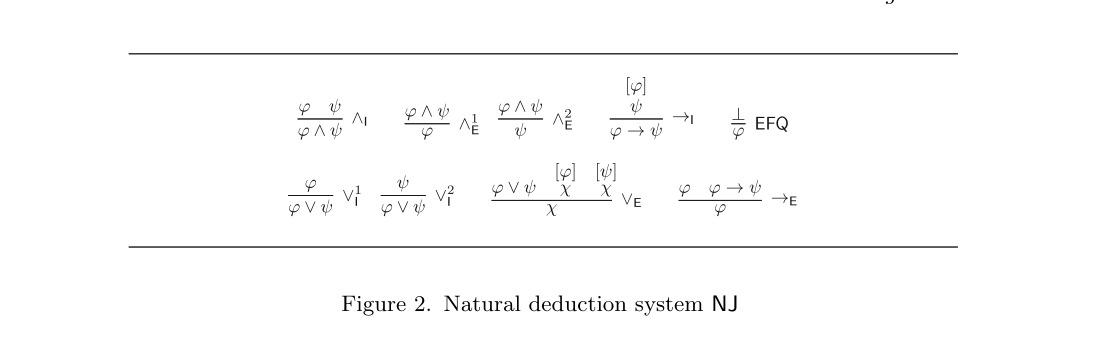
The natural deduction system NJ is composed of the rules in Figure 2.
2.2 Base-Extension Semantics for IPL
The B-eS for IPL begins by defining atomic rules. An atomic rule is a natural deduction rule of the following form, in which $q, q_1, ..., q_n$ are atoms and $Q_1, ..., Q_n$ are (possibly empty) sets of atoms: $$\dfrac{\overset{\textstyle [Q_1]}{q_1} \quad \dots \quad \overset{\textstyle [Q_n]}{q_n}}{q}$$ They may be expressed inline as $(Q_1 \rhd q_1, ..., Q_n \rhd q_n) \Rightarrow q$—note, the axiom case is the special case when the left-hand side is empty, $\Rightarrow q$. A base is a set of atomic rules. We write $B, C, ...$ to denote bases, and $\emptyset$ to denote the empty base (i.e., the base with no rules). We say C is an extension of B if C is a superset of B, denoted $C \supseteq B$. Bases are to be read as natural deduction systems in the sense of Gentzen [56]. That is, $\Rightarrow$ q means that the atom q may be concluded whenever, while $(Q_1 \rhd q_1, ..., Q_n \rhd q_n) \Rightarrow q$ means that one may derive q from a set of atoms S if, for $i = 1, ..., n$, one has derived $q_i$ from S while assuming $Q_i$. Importantly, atomic rules are taken per se and not closed under substitution when creating derivations.
Derivability in a base B is the smallest relation $\vdash_{B}$ satisfying the following:
– Ref-IPL $S, q \vdash_{B} q$.
– App-IPL If atomic rule $(Q_1 \rhd q_1, ..., Q_n \rhd q_n) \Rightarrow q \in B$, and $S, Q_i \vdash_{B} q_i$ for $i = 1, ..., n$, then $S \vdash_{B} q$. This forms the base case of the B-eS for IPL:
Support is the smallest relation satisfying the clauses of Figure 1. Every base is an extension of the empty base $(\emptyset)$, therefore $\Gamma \forces \phi$ iff $\Gamma \forces_{\emptyset} \phi$. Sandqvist [48] showed that this semantics characterizes IPL:
$\Gamma \vdash \phi$ iff $\Gamma \forces \phi$. Soundness—that is, $\Gamma \vdash \phi$ implies $\Gamma \forces \phi$—follows from showing that $\forces$ respects the rules of Gentzen’s [56] NJ; for example, $\Gamma \forces \phi$ and $\Delta \forces \psi$ implies $\Gamma, \Delta \forces \phi \land \psi$. Completeness—that is, $\Gamma \forces \phi$ implies $\Gamma \vdash \phi$—is more subtle. We give terse but complete account of it here as we use the same overall idea for IMLL in Sections 4 and 5. We require to show that $\Gamma \forces \phi$ implies that there is an NJ-proof witnessing $\Gamma \vdash \phi$. To this end, we associate to each sub-formula $\rho$ of $\Gamma \cup \{\phi\}$ a unique
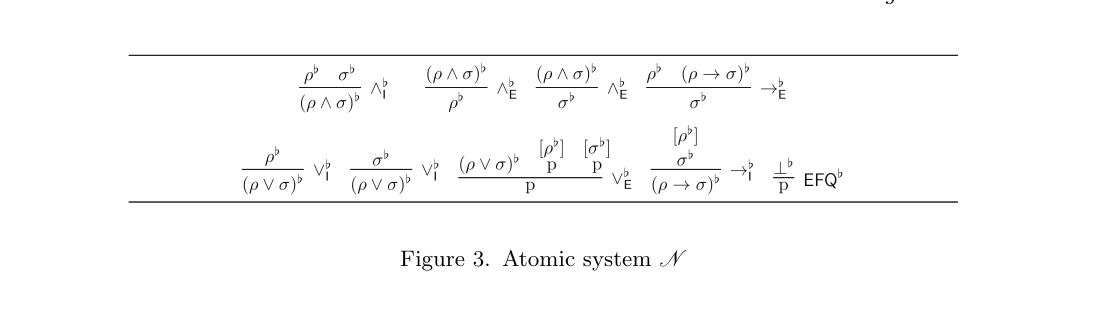
atom r, and construct a base N such that r behaves in N as $\rho$ behaves in NJ. Moreover, formulae and their atomizations are semantically equivalent in any extension of N so that support in N characterizes both validity and provability. When $\rho \in A$, we take $r := \rho$, but for a complex $\rho$ we choose r to be alien to $\Gamma$ and $\phi$.
Suppose $\rho := p \land q$ is a sub-formula of $\Gamma \cup \{\phi\}$. Associate to it a fresh atom r. Since the principal connective of $\rho$ is $\land$, we require N to contain the following rules: $$\dfrac{p \quad q}{r} \qquad \dfrac{r}{p} \qquad \dfrac{r}{q}$$ We may write $(p \land q)^\flat$ for r so that these rules may be expressed as follows: $$\dfrac{p \quad q}{(p \land q)^\flat} \qquad \dfrac{(p \land q)^\flat}{p} \qquad \dfrac{(p \land q)^\flat}{q}$$ We shall use the latter to explicate the encoded compound formulae. Formally, given a judgement $\Gamma \forces \phi$, to every sub-formula $\rho$ associate a unique atomic proposition $\rho^\flat$ as follows:
– if $\rho \notin A$, then $\rho^\flat$ is an atom that does not occur in any formula in $\Gamma \cup \{\phi\}$;
– if $\rho \in A$, then $\rho^\flat = \rho$. By unique we mean that $(\cdot)^\flat$ is injective—that is, if $\rho^\flat = \sigma^\flat$, then $\rho = \sigma$. The left-inverse of $(\cdot)^\flat$ is $(\cdot)^\natural$, and the domain may be extended to the entirety of A by identity on atoms not in the codomain of $(\cdot)^\flat$. Both functions act on sets pointwise—that is, $\Sigma^\flat := \{\phi^\flat \mid \phi \in \Sigma\}$ and $P^\natural := \{p^\natural \mid p \in P\}$. Relative to $(\cdot)^\flat$, let $\mathcal{N}$ be the base containing the rules of Figure 3 for any sub-formulae $\rho$ and $\sigma$ of $\Gamma$ and $\phi$, and any $p \in A$. Sandqvist [48] establishes three claims that deliver completeness: IPL-AtComp Let $S \subseteq A$ and $p \in A$ and let B be a base: $S \forces_{B} p$ iff $S \vdash_{B} p$.
IPL-Flat For any sub-formula $\xi$ of $\Gamma \cup \{\phi\}$ and $\mathcal{N}' \supseteq \mathcal{N}$: $\mathcal{N}' \forces \xi$ iff $\mathcal{N}' \forces \xi^\flat$. IPL-Nat Let $S \subseteq A$ and $p \in A$: if $S \forces_{\mathcal{N}} p$, then $S^\natural \vdash p^\natural$. The first claim is completeness in the atomic case. The second claim is that $\xi$ and $\xi^\flat$ are equivalent in $\mathcal{N}$—that is, $\xi \forces_{\mathcal{N}} \xi^\flat$ and $\xi^\flat \forces_{\mathcal{N}} \xi$. Consequently, $\Gamma \forces_{\mathcal{N}} \phi$ iff $\Gamma^\flat \forces_{\mathcal{N}} \phi^\flat$. The third claim is the simulation statement which allows us to make the final move from derivability in $\mathcal{N}$ to derivability in NJ. Proof of Completeness—Theorem 1. Assume $\Gamma \forces \phi$ and let $\mathcal{N}$ be its bespoke base. By IPL-Flat, $\Gamma^\flat \forces_{\mathcal{N}} \phi^\flat$. Hence, by IPL-AtComp, $\Gamma^\flat \vdash_{\mathcal{N}} \phi^\flat$. Whence, by IPL-Nat, $(\Gamma^\flat)^\natural \vdash (\phi^\flat)^\natural$—that is, $\Gamma \vdash \phi$—as required.
2.3 Base-extension Semantics for IPL, Revisited
Goldfarb [19,41] has also given a (complete) P-tS for IPL, but it mimics Kripke’s [27] semantics. What is interesting about the B-eS in Sandqvist [48] is the way in which it is not a representation of the possible-worlds semantics. This is most clearly seen in $(\lor)$, which takes the form of the ‘second-order’ definition of disjunction (see Prawitz [42]), $$U + V = \forall X((U \to X) \to (V \to X) \to X)$$ This adumbrates the category-theoretic perspective on B-eS given by Pym et al. [43,44]. Proof-theoretically, this recalls the elimination rule for the connective restricted to atomic conclusions, $$\dfrac{\phi \lor \psi \qquad \overset{\textstyle [\phi]}{p} \qquad \overset{\textstyle [\psi]}{p}}{p}$$ Indeed, all of the clauses in Figure 1 may be regarded as taking the form of the corresponding elimination rules. The principle of definitional reflection (as described in Section 1) justifies this phenomenon. According to this principle, an alternative candidate clause for conjunction is as follows:
$$\forces^{*}_{B} \phi \land \psi \quad\text{iff}\quad \text{for any } C \supseteq B \text{ and any } p \in A,\ \text{if } \phi, \psi \forces^{*}_{C} p, \text{ then } \forces^{*}_{C} p \tag{$\land'$}$$
Support $'$ is the smallest relation $\forces^{*}$ satisfying the clauses in Figure 1 with $(\land')$ replacing $(\land)$. The resulting semantics is also sound and complete for IPL:
We assume the following: for arbitrary base B, and formulae $\phi, \psi, \chi$: IPL*-Monotone — If $\forces^{*}_{B} \phi,$ then $\forces^{*}_{C} \phi$ for any C $\supseteq$ B. IPL*-AndCut — If $\forces^{*}_{B} \phi \land \psi$ and $\phi, \psi \forces^{*}_{B} \chi,$ then $\forces^{*}_{B} \chi.$ The first claim follows easily from (Inf). The second is a generalization of $(\land$); it follows by induction on the structure of $\chi—an$ analogous treatment of disjunction was given by Sandqvist [48].
They are proved at the end of this section. By Theorem 1, it suffices to show that $\Gamma \forces^{*} \phi$ iff $\Gamma \forces \phi$. For this, it suffices to show $\forces^{*}_{B} \theta$ iff $\forces_{B} \theta$ for arbitrary B and $\theta.$ We proceed by induction on the structure of $\theta.$ Since the two relations are defined identically except in the case when $\theta$ is a conjunction, we restrict our attention to this case. First, we show that $\forces_{B} \theta_1 \land\theta_2$ implies $\forces^{*}_{B} \theta_1 \land\theta_2.$ By $(\land$), the conclusion is equivalent to the following: for any C $\supseteq$ B and p $\in$ A, if $\theta_1,\theta_2 \forces^{*}_{C} p$, then $\forces^{*}_{C} p$. Therefore, fix C $\supseteq$ B and p $\in$ A such that $\theta_1,\theta_2 \forces^{*}_{C} p$. By (Inf), this entails the following: if $\forces^{*}_{C} \theta_1$ and $\forces^{*}_{C} \theta_2,$ then $\forces^{*}_{C} p$. By $(\land)$ on the assumption (i.e., $\forces_{B} \theta_1 \land \theta_2),$ we obtain $\forces_{B} \theta_1$ and $\forces_{B} \theta_2.$ Hence, by the induction hypothesis (IH), $\forces^{*}_{B} \theta_1$ and $\forces^{*}_{B} \theta_2.$ Whence, by IPL*-Monotone,
$\forces^{*}_{C} \theta_1$ and $\forces^{*}_{C} \theta_2.$ Therefore, $\forces^{*}_{C} p$. We have thus shown $\forces^{*}_{B} \theta_1\land\theta_2,$ as required. Second, we show $\forces^{*}_{B} \theta_1 \land \theta_2$ implies $\forces_{B} \theta_1 \land \theta_2.$ It is easy to see that $\theta_1,\theta_2 \forces^{*}_{B} \theta_i$ obtains for i =1, 2. Applying IPL*-AndCut (setting $\phi$= $\theta_1,$ $\psi$= $\theta_2)$ once with $\chi$= $\theta_1$ and once with $\chi$= $\theta_2$ yields $\forces^{*}_{B} \theta_1$ and $\forces^{*}_{B} \theta_2.$ By the IH, $\forces_{B} \theta_1$ and $\forces_{B} \theta_2.$ Hence, $\forces_{B} \theta_1 \land \theta_2,$ as required. A curious feature of the new semantics is that the meaning of the contextformer (i.e., the comma) is not interpreted as $\land;$ that is, defining the contextformer as
$\forces^{*}_{B} \Gamma, \Delta$ iff $\forces^{*}_{B} \Gamma$ and $\forces^{*}_{B} \Delta$ we may express (Inf) with $\Gamma \forces^{*}_{B} \phi$ iff for any C $\supseteq$ B, if $\forces^{*}_{C} \Gamma,$ then $\forces^{*}_{C} \phi$ The clause for contexts is not the same as the clause for $\land$ in the new semantics. Nonetheless, as shown in the proof of Theorem 2, they are equivalent at every base—that is, $\forces^{*}_{B} \phi, \psi$ iff $\forces^{*}_{B} \phi \land \psi$ for any B. This equivalence of the two semantics yields the following:
□For arbitrary base B and formula $\phi$, $\forces_{B} \phi$ iff, for any $X \supseteq B$ and every atom p, if $\phi \forces_{X} p$, then $\forces_{X} p$.
Let $\top$ be any formula such that $\forces \top$—for example, $\top := p \land (p \to q) \to q$. The proof uses $\top$ to transition between the two definitions of $\land$: $$\begin{aligned} \forces_{B} \phi \;&\text{iff}\; \forces_{B} \phi \text{ and } \forces_{B} \top && (\text{def. of } \top) \\ &\text{iff}\; \forces_{B} \phi \land \top && (\land) \\ &\text{iff}\; \forall X \supseteq B\ \forall p \in A,\ \text{if } \top \forces_{X} p, \text{ then } \forces_{B} p && (\land') \\ &\text{iff}\; \forall X \supseteq B\ \forall p \in A,\ \text{if } \phi \forces_{X} p, \text{ then } \forces_{B} p && (\text{def. of } \top) \end{aligned}$$ This establishes the desired equivalence.
□The significance of this result is that we see that formulae in the B-eS are precisely characterized by their support of atoms. To conclude this section we restate and prove all of the lemmas.
If $\Gamma \forces^{*}_{B} \phi,$ then $\Gamma \forces^{*}_{C} \phi$ for any C $\supseteq$ B.
By (Inf), the conclusion $\Gamma \forces^{*}_{C} \phi$ means: for every D $\supseteq$ C , if $\forces^{*}_{D} \gamma$ for every $\gamma \in \Gamma,$ then $\forces^{*}_{D} \phi.$ Since D $\supseteq$ C $\supseteq$ B, this follows by (Inf) on the hypothesis $\Gamma \forces^{*}_{B} \phi.$
□If $\forces^{*}_{B} \phi \land \psi$ and $\phi, \psi \forces^{*}_{B} \chi,$ then $\forces^{*}_{B} \chi.$
We proceed by induction on the structure of $\chi:$– $\chi$=p $\in$ A. This follows immediately by expanding the hypotheses with $(\land)$ and (Inf), choosing the atom to be $\chi.$– $\chi$= $\chi_1 \to \chi_2.$ By $(\to),$ the conclusion is equivalent to $\chi_1 \forces^{*}_{B} \chi_2.$ By (Inf), this is equivalent to the following: for any C $\supseteq$ B, if $\forces^{*}_{C} \chi_1,$ then $\forces^{*}_{C} \chi_2.$ Therefore, fix an arbitrary C $\supseteq$ B such that $\forces^{*}_{C} \chi_1.$ By the induction hypothesis (IH), it suffices to show: (1) $\forces^{*}_{C} \phi \land \psi$ and (2) for any D $\supseteq$ C , if $\forces^{*}_{D} \phi$ and $\forces^{*}_{D} \psi,$ then $\forces^{*}_{D} \chi_2.$ By IPL*-Monotone on the first hypothesis we immediately get (1). For (2), fix an arbitrary base D $\supseteq$ C such that
$\forces^{*}_{D} \phi,$ and $\forces^{*}_{D} \psi.$ By the second hypothesis, we obtain $\forces^{*}_{D} \chi_1 \to \chi_2$—that is, $\chi_1 \forces^{*}_{D} \chi_2.$ Hence, by (Inf) and IPL*-Monotone (since D $\supseteq$ B) we have
$\forces^{*}_{D} \chi_2,$ as required.
– $\chi$= $\chi_1 \land \chi_2.$ By $(\land$), the conclusion is equivalent to the following: for any C $\supseteq$ B and atomic p, if $\chi_1,\chi_2 \forces^{*}_{C} p$, then $\forces^{*}_{C} p$. Therefore, fix arbitrary C $\supseteq$ B and p such that $\chi_1,\chi_2 \forces^{*}_{C} p$. By (Inf), for any D $\supseteq$ C , if $\forces^{*}_{D} \chi_1$ and $\forces^{*}_{D} \chi_2,$ then $\forces^{*}_{Y} p$. We require to show $\forces^{*}_{C} p$. By the IH, it suffices to show the following: (1) $\forces^{*}_{C} \phi \land \psi$ and (2), for any E $\supseteq$ C , if
$\forces^{*}_{E} \phi$ and $\forces^{*}_{E} \psi,$ then $\forces^{*}_{E} p$. Since B $\subseteq$ C , By IPL*-Monotone on the first hypothesis we immediately get (1). For (2), fix an arbitrary base E $\supseteq$ C such that $\forces^{*}_{E} \phi$ and $\forces^{*}_{E} \psi.$ By the second hypothesis, we obtain $\forces^{*}_{D} p$, as required.
– $\chi$= $\chi_1 \lor\chi_2.$ By $(\lor),$ the conclusion is equivalent to the following: for any C $\supseteq$ B and atomic p, if $\chi_1 \forces^{*}_{C} p$ and $\chi_2 \forces^{*}_{C} p$, then $\forces^{*}_{C} p$. Therefore, fix an arbitrary base C $\supseteq$ B and atomic p such that $\chi_1 \forces^{*}_{C} p$ and $\chi_2 \forces^{*}_{C} p$. By the IH, it suffices to prove the following: (1) $\forces^{*}_{C} \phi \land \psi$ and (2). for any D $\supseteq$ C , if $\forces^{*}_{D} \phi$ and $\forces^{*}_{D} \psi,$ then $\forces^{*}_{D} p$. By IPL*-Monotone on the first hypothesis we immediately get (1). For (2), fix an arbitrary D $\supseteq$ C such that $\forces^{*}_{D} \phi$ and $\forces^{*}_{D} \psi.$ Since D $\supseteq$ B, we obtain $\forces^{*}_{D} \chi_1 \lor \chi_2$ by the second hypothesis. By $(\lor),$ we obtain $\forces^{*}_{D} p$, as required.
– $\chi$= $\bot.$ By $(\bot),$ the conclusion is equivalent to the following: $\forces^{*}_{B} r$ for all atomic r. By the IH, it suffices to prove the following: (1) $\forces^{*}_{B} \phi \land \psi$ and (2), for any C $\supseteq$ B, if $\forces^{*}_{C} \phi$ and $\forces^{*}_{C} \psi,$ then $\forces^{*}_{C} r$. By the first hypothesis we have (1). For (2), fix an arbitrary C $\supseteq$ B such that $\forces^{*}_{C} \phi$ and $\forces^{*}_{C} \psi.$ By the second hypothesis, $\forces^{*}_{C} \bot$ obtains. By $(\bot),$ we obtain $\forces^{*}_{C} r$, as required. This completes the induction.
□3 Intuitionistic Multiplicative Linear Logic
Having reviewed the B-eS for IPL, we turn now to intuitionistic multiplicative linear logic (IMLL). We first define IML and then analyse the challenges of giving a B-eS for it; this motivates the technical work in Section 4. Henceforth, we abandon the notation of the previous section as we do not need it and may recycle symbols and conventions. Fix a countably infinite set A of atoms.
The set of formulae F (over A) is defined by the following grammar: $$\phi, \psi ::= p \in A \mid \phi \otimes \psi \mid I \mid \phi \multimap \psi$$ We use $p, q, ...$ for atoms and $\phi, \psi, \chi, ...$ for formulae. In contrast to the work on IPL, collections of formulae in IMLL are more typically multisets. We write P, Q,... to denote finite multisets of atoms, and $\Gamma, \Delta,...$ to denote finite multisets of formulae. We use [ $\cdot$] to specify a multiset; for example, $[\phi, \phi, \psi]$ denotes the multiset consisting of two occurrence of $\phi$ and one occurrences of $\psi.$ The empty multiset (i.e., the multiset with no elements) is denoted $\emptyset.$ The union of two multisets $\Gamma$ and $\Delta$ is denoted $\Gamma, \Delta.$ We may identify a multiset containing one element with the element itself; thus, we may write $\psi,\Delta$ instead of $[\psi],\Delta$
to denote the union of multiset $\Delta$ and the singleton multiset $[\psi].$ Thus, when no confusion arises, we may write $\phi_1$, ... , $\phi_n$ to denote $[\phi_1,...,\phi_n].$ The set of all multisets over a given set X is denoted M(X). With a bit abuse of notation, we use $\subseteq$ to denote the multiset inclusion.
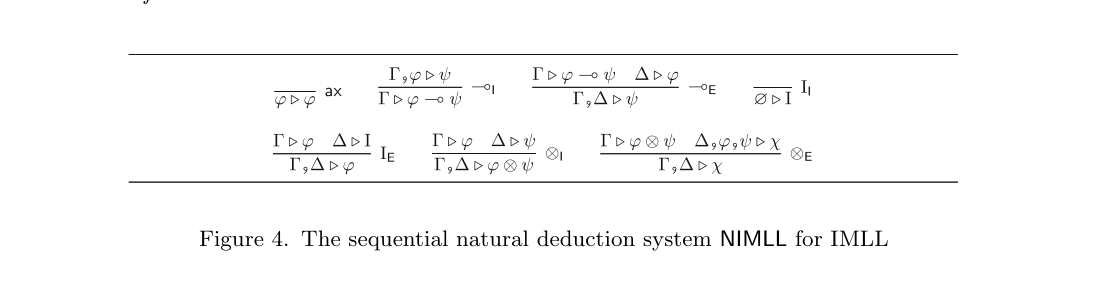
A sequent is a pair $\Gamma \rhd \phi$ in which $\Gamma$ is a multiset of formulae and $\phi$ is a formula. We characterize IMLL by proof in a natural deduction system. Since it is a substructural logic, we write the system in the format of a sequent calculus as this represents the context management explicitly. We assume general familiarity with sequent calculi—see, for example, Troelstra and Schwichtenberg [59].
The sequential natural deduction system for IMLL, denoted NIMLL, is given by the rules in Figure 4. A sequent $\Gamma \rhd \phi$ is a consequence of IMLL—denoted $\Gamma \vdash \phi$—iff there is a NIMLL-proof of it.
One may regard IMLL as IPL without the structural rules of weakening and contraction—see Došen [10]. In other words, adding the following rules to NIMLL recovers a sequent calculus for IPL: $$\dfrac{\Gamma \vdash \phi}{\Delta, \Gamma \vdash \phi}\,(w) \qquad\qquad \dfrac{\Delta, \Delta, \Gamma \vdash \phi}{\Delta, \Gamma \vdash \phi}\,(c)$$ To stay close to the work in Section 2.2 it is instructive to consider the natural deduction presentation, too. The rule figures may be the same, but their application is not; for example, $\dfrac{\Gamma \vdash \phi \qquad \Delta \vdash \psi}{\Gamma, \Delta \vdash \phi \otimes \psi}$ means if $\Gamma \vdash \phi$ and $\Delta \vdash \psi$, then $\Gamma, \Delta \vdash \phi \otimes \psi$ (i.e., not ‘if $\Gamma \vdash \phi$ and $\Gamma \vdash \psi$, then $\Gamma \vdash \phi \otimes \psi$’)
Here, it is important that the context are multisets, not as sets. The strict context management in IMLL yields the celebrated ‘resource interpretations’ of Linear Logic—see Girard [18]. The leading example of which is, perhaps, the number-of-uses reading in which a proof of a formula $\phi \psi$ determines a function that uses its arguments exactly once. This reading is, however, entirely proof-theoretic and is not expressed in the truthfunctional semantics of IMLL—see Girard [18], Allwein and Dunn [2], and Coumans et al. [8]. Though these semantics do have sense of ‘resource’ it is not via the number-of-uses reading, but instead denotational in the sense of the treatment of resources in the truth-functional semantics of the logic of Bunched Implications [36]. The number-of-uses reading is, however, reflected in the category-theoretic semantics—see Seely [53] and Biermann [4,5].
How do we render support to be sensitive to the resource reading? The subtlety is that for $\Gamma \vdash \phi$ (where $\Gamma \neq \emptyset$), we must somehow transmit the resources captured by $\Gamma$ to $\phi$. From Corollary 3, we see that in B-eS the content of a formula is captured by the atoms it supports. Therefore, we enrich the support relation with an multiset of atoms P, $$\Gamma \forces_{B}^{P} \phi \quad\text{iff}\quad \text{for any } X \supseteq B \text{ and any } U,\ \text{if } \forces_{X}^{U} \Gamma,\ \text{then } \forces_{X}^{P,U} \phi$$ where $$\forces_{B}^{U} \Gamma_1, \Gamma_2 \quad\text{iff}\quad \text{there are } U_1 \text{ and } U_2 \text{ such that } U = (U_1, U_2),\ \forces_{X}^{U_1} \Gamma_1,\ \text{and } \forces_{X}^{U_2} \Gamma_2$$ This completes the background on IMLL.
4 Base-extension Semantics for IMLL
In this section, we present a B-eS for IMLL. We begin by defining all the requisite notions such a derivability in a base and support, closely following the presentation of the B-eS for IPL in Section 2.2, but accounting for substructurality. We then prove soundness and completeness, following the strategies used for IPL, illustrating that the modifications meant to account for substructurality are correct. Importantly, as discussed below, this B-eS for IMLL enables a bone fide resource interpretation of the logic via the number-of-uses reading (restricted to atoms).
4.1 Support in a Base
The definition of the B-eS proceeds in line with that for IPL (Section 2.2) while taking substructurality into consideration.
An atomic sequent is a pair P p in which P is a multiset of atoms and q is an atom.
An atomic rule is a pair $P\Rightarrow$ p in which P is a (possibly empty) finite set of atomic sequents and p in an atom.
A base B is a (possibly infinite) set of atomic rules. The set of all bases is B.
Let $B \in \mathcal{B}$. The derivability in B relation $\vdash_{B}$ is the smallest relation satisfying the following:
– ref. $p \vdash_{B} p$.
– app. If $S_i, P_i \vdash_{B} p_i$ for $i = 1, \ldots, n$ and $(P_1 \rhd p_1, \ldots, P_n \rhd p_n) \Rightarrow p \in B$, then $S_1, \ldots, S_n \vdash_{B} p$. Note the differences between Definitions 4 and 13: first, in ref, no redundant atoms are allowed to appear, while in Ref-IPL they may; second, in app, the multisets $S_1$,. . . ,Sn are collected together as a multiset, while in App-IPL there is one set. These differences reflect the fact in the multiplicative setting that ‘resources’ can neither be discharged nor shared.
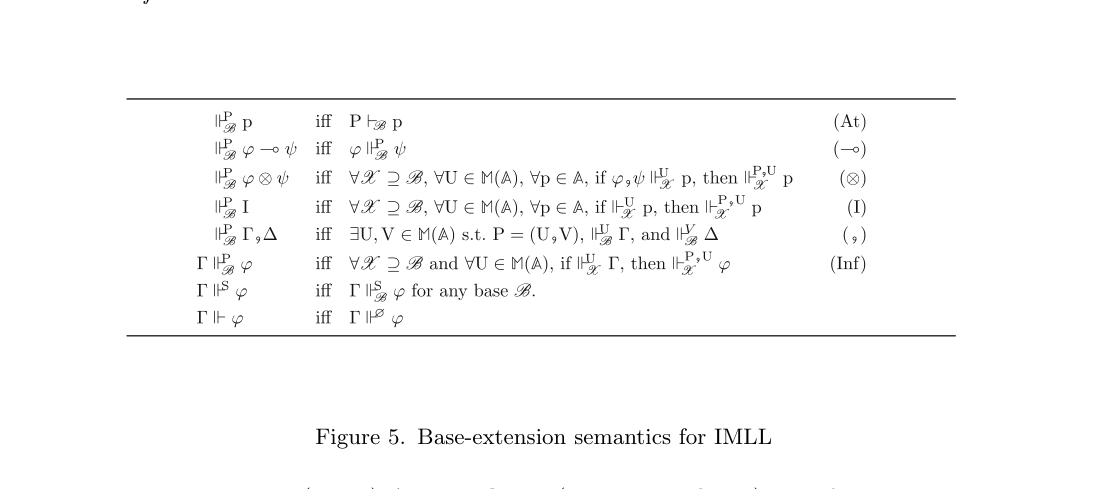
Support is the smallest relation satisfying the clauses of Figure 5 in which $\Gamma, \Delta \in \mathcal{M}(\mathcal{F})$, $P, U, V \in \mathcal{M}(A)$, and $B, X \in \mathcal{B}$. We may say that $\Gamma \rhd \phi$ is supported in the base B using resources S iff $\Gamma \forces_{B}^{S} \phi$. It is easy to see that this is an inductive definition on a structure of formulae that prioritizes conjunction $(\otimes)$ over implication $(\multimap)$—an analogous treatment in IPL with disjunction $(\lor)$ prioritized over implication $(\to)$ has been given by Sandqvist [48]. As explained in Section 3, the purpose of the multisets of atoms S in the support relation $\forces^{S}_{B}$ is to express the substructurality of the logical constants. The naive ways of using multisets of formulae rather than multisets of atoms—for example, $\Gamma \forces^{\Delta}_{B} \phi$ iff $\forces^{\Gamma, \Delta}_{B} \phi$—results in impredicative definitions of support.
The support relation − − is well-defined.
We define the degree of IMLL formulae as follows: $$deg(\phi) := \begin{cases} 1 & \text{if } \phi = p \in A \\ 2 & \text{if } \phi = I \\ deg(\phi_1) + deg(\phi_2) + 1 & \text{if } \phi = \phi_1 \otimes \phi_2 \\ deg(\phi_1) + deg(\phi_2) + 1 & \text{if } \phi = \phi_1 \multimap \phi_2 \end{cases}$$ Note that for each of (I), $(\otimes)$, and $(\multimap)$, the formulae appearing in the definitional clauses all have strictly smaller degrees than the formula itself, and the atomic case $\forces_{B}^{S}$ is defined by the derivability relation as $S \vdash_{B} p$. Therefore this is a valid inductive definition. We read (Inf) as saying that $\Gamma \forces_{B}^{S} \phi$ (for $\Gamma \neq \emptyset$) means, for any extension X of B, if $\Gamma$ is supported in X with some resources U (i.e. $\forces_{X}^{U} \Gamma$), then $\phi$ is also supported by combining the resources U with the resources S (i.e., $\forces_{X}^{S,U} \phi$). The treatment of the context-former , is consistent with the case where $\Gamma,\Delta$ is a singleton. The following observation on the monotonicity of the semantics with regard to base extensions follows immediately by unfolding definitions:
□If $\Gamma \forces_{B}^{S} \phi$ and C $\supseteq$ B, then $\Gamma \forces_{C}^{S} \phi.$
By (Inf), it suffices to show the following: for any $B \in \mathcal{B}$, any $S \in \mathcal{M}(A)$, and any $\phi \in \mathcal{F}$, if $\forces_{B}^{S} \phi$ and $C \supseteq B$, then $\forces_{C}^{S} \phi$. We proceed by induction on $\forces^{*}$ (see Definition 14).
– base case. In this case, $\forces_{B}^{S} \phi$ is of the form $\forces_{B}^{S} p$, where $p \in A$. By (At), infer $S \vdash_{B} p$. Since $C \supseteq B$, every rule in B is also a rule in C, so $S \vdash_{C} p$. By (At), conclude $\forces_{C}^{S} p$.
– inductive step. For the inductive cases $(\otimes)$, (I), $(\multimap)$ (expanded using (Inf) and (,)), note that each takes an arbitrary extension of B—that is, says ‘for every $X \supseteq B$, . . . ’—so the conclusion follows immediately. If the statement takes place over an arbitrary $C \supseteq B$, such extensions also holds; that is, we choose $X \supseteq C$. Therefore the inductive steps also pass. To see an example, consider $\phi$ of the form $\sigma \multimap \tau$. Assume $\forces_{B}^{S} \sigma \multimap \tau$ and $C \supseteq B$, we show that $\forces_{C}^{S} \sigma \multimap \tau$. According to $(\multimap)$, the goal is $\sigma \forces_{C}^{S} \tau$. By (Inf), we fix some arbitrary $D \supseteq C$ and $T \in \mathcal{M}(A)$ such that $\forces_{D}^{T} \sigma$, and show $\forces_{D}^{S,T} \tau$.
This follows immediately from $\forces_{B}^{S} \sigma \multimap \tau$, since $D \supseteq C \supseteq B$. This completes the induction.
□Proof. Recall that the definition that $\Gamma \forces^{S} \phi$ means the following: for any base $B$, $\Gamma \forces_{B}^{S} \phi$ holds.
– $\Rightarrow$. By definition, $\Gamma \forces^{S} \phi$ implies that in particular, $\Gamma \forces_{\emptyset}^{S} \phi$ holds.
– $\Leftarrow$.
Suppose $\Gamma \forces^{S} \phi$ holds. For arbitrary $B \in \mathcal{B}$, since $B \supseteq \emptyset$ holds, we can apply Proposition 7 and conclude that $\Gamma \forces_{B}^{S} \phi$ holds. Since this is true for arbitrary base B, we have $\Gamma \forces^{S} \phi$. This completes the proof. As expected, we do not have monotonicity on resources—that is, $\Gamma \forces^{S} \phi$ does not, in general, imply $\Gamma \forces^{S,T} \phi$ for arbitrary T. This exposes the different purposes of the bases and the resources in the semantics: bases are the setting in which a formula is supported, resources are tokens used in that setting to establish the support. A distinguishing aspect of support is the structure of (Inf). In one direction, it is merely cut, but in the other it says something stronger. The completeness argument will go through the atomic case (analogous to the treatment of IPL in Section 2.2), and the following proposition suggests that the setup is correct:
Let $B \in \mathcal{B}$, $P, S \in \mathcal{M}(A)$, and $q \in A$ be arbitrary such that $P = [p_1, \ldots, p_n]$. $$P, S \vdash_{B} q \quad\text{iff}\quad \forall X \supseteq B \text{ and } \forall T_1, \ldots, T_n \in \mathcal{M}(A),\ \text{if } T_i \vdash_{X} p_i \text{ for } i = 1, \ldots, n, \text{ then } T_1, \ldots, T_n, S \vdash_{X} q.$$
Let (1) be the statement $P, S \vdash_{B} q$ and (2) be the statement: $\forall X \supseteq B$ and $\forall T_1, \ldots, T_n \in \mathcal{M}(A)$, if $T_i \vdash_{X} p_i$ for $i = 1, \ldots, n$, then $T_1, \ldots, T_n, S \vdash_{X} q$. It is straightforward to see that (2) entails (1): we take X to be B, and $T_i$ to be $[p_i]$ for each $i = 1, \ldots, n$. Since $p_1 \vdash_{B} p_1, \ldots, p_n \vdash_{B} p_n$ all hold by ref, it follows from (2) that $p_1, \ldots, p_n, S \vdash_{B} q$, namely $P, S \vdash_{B} q$. As for (1) entails (2), we proceed by induction on how $P, S \vdash_{B} q$ is derived (see Definition 13).
– $P, S \vdash_{B} q$ holds by ref. That is, $P, S = [q]$, and $q \vdash_{B} q$ follows by ref. Here are two subcases, depending on which of P and S is $[q]$.
– Suppose $P = [q]$ and $S = \emptyset$. So (2) becomes: for every $X \supseteq B$ and T, if $T \vdash_{X} q$, then $T \vdash_{X} q$. This holds a fortiori.
– Suppose $S = [q]$ and $P = \emptyset$. Since $P = \emptyset$, (2) becomes: for every $X \supseteq B$, $S \vdash_{X} q$. This holds by ref. – $P, S \vdash_{B} q$ holds by app. We assume that $P = P_1, \ldots, P_k$, $S = S_1, \ldots, S_k$, and the following hold for some $Q_1, \ldots, Q_k$ and $r_1, \ldots, r_k$: $$P_1, S_1, Q_1 \vdash_{B} r_1, \ldots, P_k, S_k, Q_k \vdash_{B} r_k \tag{3}$$ $$(Q_1 \rhd r_1, \ldots, Q_k \rhd r_k) \Rightarrow q \text{ is in } B \tag{4}$$ In order to prove (2), we fix some arbitrary base $C \supseteq B$ and atomic multisets $T_1, \ldots, T_n$ such that $T_1 \vdash_{C} p_1, \ldots, T_n \vdash_{C} p_n$, and show $T_1, \ldots, T_n, S \vdash_{C} q$. Let us assume $P_i = p_{i1}, \ldots, p_{i\ell_i}$ for each $i = 1, \ldots, k$. We apply IH to every $P_i, S_i, Q_i \vdash_{B} r_i$ from 3, and get $T_{i1}, \ldots, T_{i\ell_i}, S_i, Q_i \vdash_{C} r_i$. Moreover, the atomic rule from 4 is also in C, since $C \supseteq B$. Therefore we can apply app and get $$T_{11}, \ldots, T_{1\ell_1}, S_1, \ldots, T_{k1}, \ldots, T_{k\ell_k}, S_k \vdash_{C} q.$$ By the definition of $S_i$ and $T_{ij}$, this is precisely $T_1, \ldots, T_n, S \vdash_{C} q$. This completes the inductive proof. It remains to prove soundness and completeness.
□4.2 Soundness
If $\Gamma \vdash \phi$, then $\Gamma \forces \phi$.
The argument follows a typical strategy of showing that the semantics respects the rules of NIMLL—that is, for any $\Gamma, \Delta, \phi, \psi,$ and $\chi$: $$\begin{aligned} \text{(Ax)} \quad& \phi \forces \phi \\ (\multimap\text{I}) \quad& \text{If } \Gamma, \phi \forces \psi, \text{ then } \Gamma \forces \phi \multimap \psi \\ (\multimap\text{E}) \quad& \text{If } \Gamma \forces \phi \multimap \psi \text{ and } \Delta \forces \phi, \text{ then } \Gamma, \Delta \forces \psi \\ (\otimes\text{I}) \quad& \text{If } \Gamma \forces \phi \text{ and } \Delta \forces \psi, \text{ then } \Gamma, \Delta \forces \phi \otimes \psi \\ (\otimes\text{E}) \quad& \text{If } \Gamma \forces \phi \otimes \psi \text{ and } \Delta, \phi, \psi \forces \chi, \text{ then } \Gamma, \Delta \forces \chi \\ (\text{II}) \quad& \forces I \\ (\text{IE}) \quad& \text{If } \Gamma \forces \chi \text{ and } \Delta \forces I, \text{ then } \Gamma, \Delta \forces \chi \end{aligned}$$ These follow quickly from the fact that the clauses of each connective in Figure 5 takes the form of its elimination rules. The only subtle cases are $(\otimes\text{E})$ and (IE).
First, consider (IE). Suppose $\Gamma \forces \chi$ and $\Delta \forces I$. We require to show $\Gamma, \Delta \forces \chi$. By (Inf), we fix some base B and multisets of atoms P and Q such that $\forces_{B}^{P} \Gamma$ and $\forces_{B}^{Q} \Delta$. It remains to verify $\forces_{B}^{P,Q} \chi$. When $\chi$ is atomic, this follows immediately from $\forces_{B}^{P} \chi$ and $\forces_{B}^{Q} I$ by (I). To handle non-atomic $\chi$, we require the following: $$\forall B \in \mathcal{B}\ \forall S, T \in \mathcal{M}(A)\ \forall \chi \in \mathcal{F},\ \text{if } \forces_{B}^{S} I \text{ and } \forces_{B}^{T} \chi, \text{ then } \forces_{B}^{S,T} \chi. \tag{Lemma 11}$$
This lemma follows by induction on the structure of $\chi$, with the base case given by (I). One cannot use this general form to define I as it would result in an impredicative definition of support.
Similarly, we require the following to prove $(\otimes\text{E})$: $$\forall B \in \mathcal{B}\ \forall S, T \in \mathcal{M}(A)\ \forall \phi, \psi, \chi \in \mathcal{F},\ \text{if } \forces_{B}^{S} \phi \otimes \psi \text{ and } \phi, \psi \forces_{B}^{T} \chi, \text{ then } \forces_{B}^{S,T} \chi.$$ With these results, which are proved at the end of this section, we may prove soundness:
Proof of Theorem 10 — Soundness. We demonstrate $(\otimes\text{I})$ and $(\otimes\text{E})$.
– $(\otimes\text{I})$. Assume $\Gamma \forces \phi$ and $\Delta \forces \psi$, we require to show $\Gamma, \Delta \forces \phi \otimes \psi$. By (Inf), the conclusion is equivalent to the following: $\forall B \in \mathcal{B}\ \forall T, S \in \mathcal{M}(A)$, if $\forces_{B}^{T} \Gamma$ and $\forces_{B}^{S} \Delta$, then $\forces_{B}^{T,S} \phi \otimes \psi$. So we fix some B and $T, S$ such that $\forces_{B}^{T} \Gamma$ and $\forces_{B}^{S} \Delta$, and show that $\forces_{B}^{T,S} \phi \otimes \psi$. By $(\otimes)$, it suffices to show: $\forall C \supseteq B\ \forall U \in \mathcal{M}(A)\ \forall p \in A$, if $\phi, \psi \forces_{C}^{U} p$, then $\forces_{C}^{T,S,U} p$. So we fix some $C \supseteq B$, multiset of atoms U, and atom p such that $\phi, \psi \forces_{C}^{U} p$, and the goal is to show that $\forces_{C}^{T,S,U} p$. From the assumptions $\Gamma \forces \phi$ and $\Delta \forces \psi$, we see that $\forces_{B}^{S,T} \phi, \psi$ obtains. Therefore, by monotonicity, $\forces_{C}^{S,T} \phi, \psi$ obtains. By (Inf), infer $\forces_{C}^{T,S,U} p$, as required.
– $(\otimes\text{E})$. Assume $\Gamma \forces \phi \otimes \psi$ and $\Delta, \phi, \psi \forces \chi$. We require to show $\Gamma, \Delta \forces \chi$. By (Inf), it suffices to assume $\forces_{B}^{S} \Gamma$ and $\forces_{B}^{T} \Delta$ and show that $\forces_{B}^{S,T} \chi$. First, $\Gamma \forces \phi \otimes \psi$ together with $\forces_{B}^{S} \Gamma$ entails that $\forces_{B}^{S} \phi \otimes \psi$. Second, by (Inf), $\Delta, \phi, \psi \forces \chi$ is equivalent to the following: $$\forall X \in \mathcal{B}\ P, Q \in \mathcal{M}(A),\ \text{if } \forces_{X}^{P} \Delta \text{ and } \forces_{X}^{Q} \phi, \psi, \text{ then } \forces_{X}^{P,Q} \chi$$ Since $\forces_{B}^{T} \Delta$, setting $P := T$ and $Q := S$, yields, $$\forall X \supseteq B,\ \text{if } \forces_{X}^{S} \phi, \psi, \text{ then } \forces_{X}^{T,S} \chi \tag{1}$$ Now, given $\forces_{B}^{S} \phi \otimes \psi$ and (1), we can apply Lemma 12 and conclude $\forces_{B}^{S,T} \chi$. This concludes the case analysis.
For arbitrary base B, multisets of atoms S, T, and formula $\chi$, if 1. $\forces_{B}^{S} I$, 2. $\forces_{B}^{T} \chi$, then 3. $\forces_{B}^{S,T} \chi$.
We proceed by induction on the structure of $\chi$:
– $\chi = p \in A$. This case follows immediately from (I).
– $\chi = I$. Fix $C \supseteq B$, $W \in \mathcal{M}(A)$, and $q \in A$ such that $\forces_{C}^{W} q$. It suffices to prove that $\forces_{C}^{S,T,W} q$. By (I) on (1) using $\forces_{C}^{W} q$, infer $\forces_{C}^{S,W} q$. By monotonicity on (2), infer $\forces_{C}^{T} q$. By (I) on (1) using this, infer $\forces_{C}^{S,T,W} q$, as required.
– $\chi = \sigma \otimes \tau$. By $(\otimes)$, the conclusion (3) is equivalent to the following: $\forall X \supseteq B$, $U$ $\forall p \in A$, if $\sigma, \tau \forces_{X}^{U} p$, then $\forces_{X}^{S,T,U} p$. Therefore, fix $C \supseteq B$, $W \in \mathcal{M}(A)$, and $q \in A$ such that $\sigma, \tau \forces_{C}^{W} q$; we require to show $\forces_{C}^{S,T,W} q$. By (2) and monotonicity, infer $\forces_{C}^{T} \sigma \otimes \tau$. By Lemma 12, infer $\forces_{C}^{T,W} q$. By (I) on (1), conclude $\forces_{C}^{S,T,W} q$, as required.
– $\chi = \sigma \multimap \tau$. By $(\multimap)$, the conclusion (3) is equivalent to $\sigma \forces_{B}^{S,T} \tau$. Fix some base $C \supseteq B$ and $W \in \mathcal{M}(A)$ such that $\forces_{C}^{W} \sigma$. By (Inf), it suffices to show that $\forces_{C}^{S,T,W} \tau$. By the IH, from $\forces_{C}^{S} I$ and $\forces_{C}^{W} \sigma$, infer $\forces_{C}^{S,W} \sigma$. By (I) on (2), infer $\forces_{C}^{S,T,W} \tau$, as required. This completes the induction.
□For arbitrary base B, multisets of atoms S, T, and formulae $\phi, \psi, \chi$, if 1. $\forces_{B}^{S} \phi \otimes \psi$, 2. $\phi, \psi \forces_{B}^{T} \chi$, then 3. $\forces_{B}^{S,T} \chi$.
We proceed by induction on the structure of $\chi$:
– $\chi = p \in A$. This case follows immediately from $(\otimes)$.
– $\chi = I$. Expanding (3) with (I) yields: $\forall X \supseteq B\ \forall U \in \mathcal{M}(A)\ \forall p \in A$, if $\forces_{X}^{U} p$, then $\forces_{X}^{S,T,U} p$. Therefore, fix a base $C \supseteq B$, $Q \in \mathcal{M}(A)$, and $q \in A$, such that $\forces_{C}^{Q} q$, we require to show $\forces_{C}^{S,T,Q} q$. By $(\otimes)$, it suffices to show the following: $(\dagger)\ \forces_{C}^{S} \phi \otimes \psi$ and $(\dagger\dagger)\ \phi, \psi \forces_{C}^{T,Q} q$. We have $(\dagger)$ from (1) since $C \supseteq B$. For $(\dagger\dagger)$, fix $D \supseteq C$ and $R_1, R_2 \in \mathcal{M}(A)$ such that $\forces_{D}^{R_1} \phi$ and $\forces_{D}^{R_2} \psi$; we require to show $\forces_{D}^{T,Q,R_1,R_2} q$. By (Inf), condition (2) becomes $\phi, \psi \forces_{B}^{T} I$. Hence, together with $\forces_{D}^{R_1} \phi$ and $\forces_{D}^{R_2} \psi$, it follows that $\forces_{D}^{T,R_1,R_2} I$. By (I), infer $\forall X \supseteq D\ \forall U \in \mathcal{M}(A)\ \forall p \in A$, if $\forces_{X}^{U} p$, then $\forces_{X}^{T,R_1,R_2,U} p$. Since $\forces_{C}^{Q} q$ and $D \supseteq C$, infer $\forces_{D}^{Q} q$, therefore $\forces_{D}^{T,R_1,R_2,Q} q$, as required.
– $\chi = \sigma \multimap \tau$. By $(\multimap)$ and (Inf), condition (3) becomes: $\forall X \supseteq B\ \forall U \in \mathcal{M}(A)$, if $\forces_{X}^{U} \sigma$, then $\forces_{X}^{S,T,U} \tau$. Therefore, fix $C \supseteq B$ and $P \in \mathcal{M}(A)$ such that $\forces_{C}^{P} \sigma$; we require to show $\forces_{C}^{S,T,P} \tau$. By the IH, it suffices to show the following: $(\dagger)\ \forces_{C}^{S} \phi \otimes \psi$ and $(\dagger\dagger)\ \phi, \psi \forces_{C}^{T,P} \tau$. We have $(\dagger)$ from (1). For $(\dagger\dagger)$, fix $D \supseteq C$ and $Q \in \mathcal{M}(A)$ such that $\forces_{D}^{Q} [\phi, \psi]$; we require to show $\forces_{D}^{Q,T,P} \tau$. By (2) using $\forces_{D}^{Q} [\phi, \psi]$, infer $\forces_{D}^{Q,T} \sigma \multimap \tau$. By (I), infer $\sigma \forces_{D}^{Q,T} \tau$. Since $\forces_{C}^{P} \sigma$, by monotonicity we have $\forces_{D}^{P} \sigma$. Hence, by (Inf), conclude $\forces_{D}^{Q,T,P} \tau$, as required.
– $\chi = \sigma \otimes \tau$. Fix $C \supseteq B$, $P \in \mathcal{M}(A)$, $p \in A$ such that $\sigma, \tau \forces_{C}^{P} p$. By $(\otimes)$ on 3, it suffices to show $\forces_{C}^{S,T,P} p$. By the IH, it suffices to prove the following: $(\dagger)\ \forces_{C}^{S} \phi \otimes \psi$ and $(\dagger\dagger)\ \phi, \psi \forces_{C}^{T,P} p$. We have $(\dagger)$ from (1), by monotonicity.
For $(\dagger\dagger)$, fix $D \supseteq C$ and $Q \in \mathcal{M}(A)$ such that $\forces_{D}^{Q} \phi, \psi$; we require to show $\forces_{D}^{Q,T,P} p$. By (2), from $\forces_{D}^{Q} \phi, \psi$ infer $\forces_{D}^{Q,T} \sigma \otimes \tau$. By $(\otimes)$, infer $$\text{for every } Y \supseteq D,\ V \text{ and } q,\ \text{if } \sigma, \tau \forces_{Y}^{V} q, \text{ then } \forces_{Y}^{Q,T,V} q. \tag{1}$$ Since $\sigma, \tau \forces_{D}^{P} p$, conclude $\forces_{D}^{Q,T,P} p$, as required. This completes the induction.
□4.3 Completeness
If $\Gamma \forces \phi$, then $\Gamma \vdash \phi$.
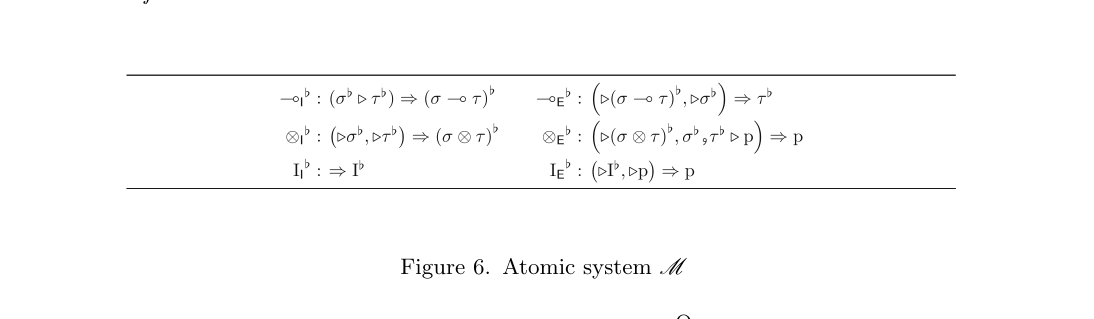
The argument follows the strategy used by Sanqvist [48] for IPL—see Section 2.2. Let $\Xi$ be the set of all sub-formulae of $\Gamma \cup \{\phi\}$. Let $(\cdot)^\flat : \Xi \to A$ be an injection that is fixed on $\Xi \cap A$—that is, $p^\flat = p$ for $p \in \Xi \cap A$. Let $(\cdot)^\natural$ be the left-inverse of $(\cdot)^\flat$—that is $p^\natural = \chi$ if $p = \chi^\flat$, and $p^\natural = p$ if p is not in the image of $(\cdot)^\flat$. Both act on multisets of formulae pointwise; that is, $\Delta^\flat := [\delta^\flat \mid \delta \in \Delta]$ and $P^\natural := [p^\natural \mid p \in P]$. We construct a base M such that $\phi^\flat$ behaves in M as $\phi$ behaves in NIMLL. The base M contains all instances of the rules of Figure 6 when $\sigma$ and $\tau$ range over $\Xi$, and p ranges over A. We illustrate how M works with an example.
Consider the sequent $\Gamma \rhd \phi$ where $\Gamma = [p_1, p_2, p_1 \otimes p_2 \multimap q, p_1]$ and $\phi = q \otimes p_1$. By definition, $\Xi := \{p_1, p_2, p_1 \otimes p_2 \multimap q, p_1 \otimes p_2, q, q \otimes p_1\}$, and, therefore, the image of $(\cdot)^\flat$ is $\{p_1, p_2, q, (p_1 \otimes p_2 \multimap q)^\flat, (p_1 \otimes p_2)^\flat, (q \otimes p_1)^\flat\}$.
That $\Gamma \vdash \phi$ obtains is witnessed by the following NIMLL-proof: $$\dfrac{\dfrac{\dfrac{p_1 \rhd p_1 \qquad p_2 \rhd p_2}{p_1, p_2 \rhd p_1 \otimes p_2}\,(\otimes\text{I}) \qquad p_1 \otimes p_2 \multimap q \rhd p_1 \otimes p_2 \multimap q}{p_1, p_2, p_1 \otimes p_2 \multimap q \rhd q}\,(\multimap\text{E}) \qquad p_1 \rhd p_1}{p_1, p_2, p_1 \otimes p_2 \multimap q, p_1 \rhd q \otimes p_1}\,(\otimes\text{I})$$ The base M is designed so that we may simulate the rules of NIMLL; for example, the $\otimes$E is simulated by using app on $\otimes^\flat_{\text{E}}$, $$(\emptyset \rhd (\sigma \otimes \tau)^\flat, \sigma^\flat, \tau^\flat \rhd \gamma^\flat) \Rightarrow \gamma^\flat$$
means if $\Delta^\flat \vdash_M (\sigma \otimes \tau)^\flat$ and $\Sigma^\flat, \sigma^\flat, \tau^\flat \vdash_M \gamma^\flat$ then $\Delta^\flat, \Sigma^\flat \vdash_M \gamma^\flat$. In this sense, the proof above is simulated by the following steps:
(i) By ref, (1) $p_1 \vdash_M p_1$; (2) $p_2 \vdash_M p_2$; (3) $(p_1 \otimes p_2 \multimap q)^\flat \vdash_M (p_1 \otimes p_2 \multimap q)^\flat$
(ii) By app, using $(\otimes\text{I})$ on (1) and (2), we obtain (4) $p_1, p_2 \vdash_M (p_1 \otimes p_2)^\flat$
(iii) By app, using $(\multimap\text{E})^\flat$ on (3) and (4), we obtain (5) $(p_1 \otimes p_2 \multimap q)^\flat, p_1, p_2 \vdash_M q$
(iv) By app, using $(\otimes\text{I})^\flat$ on (1) and (5), we have $(p_1 \otimes p_2 \multimap q)^\flat, p_1, p_2, p_1 \vdash_M (q \otimes p_1)^\flat$.
Significantly, steps (i)–(iv) are analogues of the steps in the proof tree above.
Completeness follows from the following three observations, which are counterparts to IPL-AtComp, IPL-Flat, and IPL-Nat from Section 2.2:
IMLL-AtComp For any B, P, S, and q, $P, S \vdash_B q$ iff $P \forces_B^S q$.
IMLL-Flat For any $\xi \in \Xi$, $X \supseteq M$ and U, $\forces_X^U \xi^\flat$ iff $\forces_X^U \xi$.
IMLL-Nat For any P and q, if $P \vdash_M q$ then $P^\natural \vdash q^\natural$.
They are proved at the end of this section. First, IMLL-AtComp follows from Proposition 9 and is the base case of completeness. Second, IMLL-Flat formalizes the idea that every formula $\xi$ appearing in $\Gamma \rhd \phi$ behaves the same as $\xi^\flat$ in any base extending M; consequently, $\Gamma^\flat \forces_M \phi^\flat$ iff $\Gamma \forces_M \phi$. Thirdly, IMLL-Nat intuitively says that M is a faithful atomic encoding of NIMLL, witnessed by $(\cdot)^\natural$.
(Theorem 13—Completeness) Assume $\Gamma \forces \phi$ and let M be the bespoke base for $\Gamma \rhd \phi$. By IMLL-Flat, $\Gamma^\flat \forces_M^\emptyset \phi^\flat$. Therefore, by IMLL-AtComp, we have $\Gamma^\flat \vdash_M \phi^\flat$. Finally, by IMLL-Nat, $\left(\Gamma^\flat\right)^\natural \vdash \left(\phi^\flat\right)^\natural$—that is, $\Gamma \vdash \phi$. The required lemmas for the simulation argument hold because of the close relationship between proof for IMLL, derivability in M, and the clauses of the semantics.
□The following holds for arbitrary base $B \supseteq M$ and atomic multiset S, when $\sigma \multimap \tau$, $\sigma \otimes \tau$, or I is in $\Xi$, respectively:
- $S \vdash_B (\sigma \multimap \tau)^\flat$ iff $S, \sigma^\flat \vdash_B \tau^\flat$.
- $S \vdash_B (\sigma \otimes \tau)^\flat$ iff for every $Y \supseteq B$, V, p, if $V, \sigma^\flat, \tau^\flat \vdash_Y p$, then $S, V \vdash_Y p$.
- $S \vdash_B I^\flat$ iff for every $Y \supseteq B$, V, p, if $V \vdash_Y p$, then $S, V \vdash_Y p$.
Proof. Let us fix arbitrary base $B \supseteq M$ and atomic multiset S.
1. We prove the two directions separately.
– Left to right: We assume $S \vdash_B (\sigma \multimap \tau)^\flat$. Note that $\sigma^\flat \vdash_B \sigma^\flat$ by ref. Also, the atomic rule $$\langle \rhd (\sigma \multimap \tau)^\flat, \rhd \sigma^\flat \rangle \Rightarrow \tau^\flat$$ is in M thus in B. Therefore, by app we can conclude $S, \sigma^\flat \vdash_B \tau^\flat$.
– Right to left: We assume $S, \sigma^\flat \vdash_B \tau^\flat$. Together with that $(\sigma^\flat \rhd \tau^\flat) \Rightarrow (\sigma \multimap \tau)^\flat$ is in M thus in B, it follows from app that $S \vdash_B (\sigma \multimap \tau)^\flat$.
2. Again we show the two directions separately.
– Left to right: We assume $S \vdash_B (\sigma \otimes \tau)^\flat$. It suffices to fix some $C \supseteq B$, T and q satisfying $T, \sigma^\flat, \tau^\flat \vdash_C q$, and then show $S, T \vdash_C q$. Note that the atomic rule $$\langle \rhd (\sigma \otimes \tau)^\flat, \sigma^\flat, \tau^\flat \rhd q \rangle \Rightarrow q$$ is in B thus also in C, therefore from the two assumptions we can derive $S, T \vdash_C q$.
– Right to left: We assume that for every $Y \supseteq B$, V, and p, if $V, \sigma^\flat, \tau^\flat \vdash_Y p$, then $S, V \vdash_Y p$. The goal is to show $S \vdash_B (\sigma \otimes \tau)^\flat$. In particular, suppose we have $\sigma^\flat, \tau^\flat \vdash_B (\sigma \otimes \tau)^\flat$, then $S \vdash_B (\sigma \otimes \tau)^\flat$ immediately follows from the assumption. To show $\sigma^\flat, \tau^\flat \vdash_B (\sigma \otimes \tau)^\flat$, it suffices to apply app to the atomic rule $\langle \rhd \sigma^\flat, \rhd \tau^\flat \rangle \Rightarrow (\sigma \otimes \tau)^\flat$ in B as well as the fact that both $\sigma^\flat \vdash_B \sigma^\flat$ and $\tau^\flat \vdash_B \tau^\flat$ hold (using ref).
3. We prove the two directions separately.
• Left to right: We fix some $C \supseteq B$, T, and q such that $T \vdash_C q$, and the goal is to show that $S, T \vdash_C q$ holds. Notice that the atomic rule $\langle \rhd I^\flat, \rhd \tau^\flat \rangle \Rightarrow \tau^\flat$ is in B thus in C, so apply app to this rule together with $S \vdash_C I^\flat$ (immediate consequence of $S \vdash_B I^\flat$ and $C \supseteq B$) and $T \vdash_C q$ entails that $S, T \vdash_C q$.
• Right to left: This is the simpler direction. Since the atomic rule $\Rightarrow I^\flat$ is in B, using app we have $\vdash_B I^\flat$. The RHS of the statement entails that $S \vdash_B I^\flat$.
This completes the proof for all the three statements.
For arbitrary base $B \in \mathcal{B}$, any $P, S \in \mathcal{M}(A)$, and any $q \in A$, $$P, S \vdash_B q \quad\text{iff}\quad P \forces_B^S q.$$
The equivalence follows immediately from Proposition 9. Let us assume that $P = [p_1, \ldots, p_n]$. Starting from $P \forces_B^S q$, by (Inf), it means for every base $X \supseteq B$ and atomic multisets $T_1, \ldots, T_n$, $\forces_X^{T_1} p_1, \ldots, \forces_X^{T_n} p_n$ implies $\forces_X^{S,T} q$. Spelling out the definition of $\forces_B$ for atoms IMLL-AtComp, $P \forces_B^S q$ is equivalent to that, for every base $X \supseteq B$ and atomic multisets $T_1, \ldots, T_n$, $T_1 \vdash_X p_1, \ldots, T_n \vdash_X p_n$ implies $S, T \vdash_X q$. This is precisely $P, S \vdash_B q$, given Proposition 9.
□For any $\xi \in \Xi$, $X \supseteq M$ and U, $\forces_X^U \xi^\flat$ iff $\forces_X^U \xi$.
We fix an arbitrary base $B \supseteq M$ and atomic multiset S, and proceed by induction on the structure of $\xi$.
– $\xi$ is atomic. Then by definition, $\xi^\flat = \xi$, so the statement is a tautology.
– $\xi$ is I. $$\begin{array}{ll} & \forces_B^S I^\flat \\ \text{iff} & S \vdash_B I^\flat \quad \text{(IMLL-AtComp)} \\ \text{iff} & \forall X \supseteq B,\, U,\, p,\ \text{if } U \vdash_X p, \text{ then } S, U \vdash_X p \quad \text{(Lemma 14)} \\ \text{iff} & \forall X \supseteq B,\, U,\, p,\ \text{if } \forces_X^U p, \text{ then } \forces_X^{S,U} p \quad \text{(IMLL-AtComp)} \\ \text{iff} & \forces_B^S I \quad \text{(I)} \end{array}$$
– $\xi$ is of the form $\sigma \multimap \tau$. $$\begin{array}{ll} & \forces_B^S (\sigma \multimap \tau)^\flat \\ \text{iff} & S \vdash_B (\sigma \multimap \tau)^\flat \quad \text{(IMLL-AtComp)} \\ \text{iff} & \sigma^\flat \forces_B^S \tau^\flat \quad \text{(Lemma 14)} \\ \text{iff} & \sigma \forces_B^S \tau \quad \text{(IH)} \\ \text{iff} & \forces_B^S \sigma \multimap \tau \quad (\multimap) \end{array}$$
– $\xi$ is of the form $\sigma \otimes \tau$. $$\begin{array}{ll} & \forces_B^S (\sigma \otimes \tau)^\flat \\ \text{iff} & S \vdash_B (\sigma \otimes \tau)^\flat \quad \text{(IMLL-AtComp)} \\ \text{iff} & \forall X \supseteq B,\, U,\, p,\ \text{if } \sigma^\flat, \tau^\flat \forces_X^U p, \text{ then } \forces_X^{S,U} p \quad \text{(Lemma 14)} \\ \text{iff} & \forall X \supseteq B,\, U,\, p,\ \text{if } \sigma, \tau \forces_X^U p, \text{ then } \forces_X^{S,U} p \quad \text{(IH)} \\ \text{iff} & \forces_B^S \sigma \otimes \tau \quad (\otimes). \end{array}$$ This completes the induction.
□For any $P \in \mathcal{M}(A)$ and $q \in A$, if $P \vdash_M q$ then $P^\natural \vdash q^\natural$.
By the definition of $\vdash_M$ (Definition 13), it suffices to show the following: $$p^\natural \vdash p^\natural \tag{2}$$ and $$\text{if } ((P_1 \rhd q_1), \ldots, (P_n \rhd q_n) \Rightarrow r) \in M, \text{ and } S_1^\natural, P_1^\natural \vdash q_1^\natural, \ldots, S_n^\natural, P_n^\natural \vdash q_n^\natural, \text{ then } S_1^\natural, \ldots, S_n^\natural \vdash r^\natural. \tag{3}$$ First, 2 follows immediately from ax. Second, for 3, we simply need to prove the statement for each atomic rule in base M, which according to the definition of M amounts to proving the following facts:
– Suppose $(\sigma^\flat \rhd \tau^\flat) \Rightarrow (\sigma \multimap \tau)^\flat$ is in M, and $S^\natural, (\sigma^\flat)^\natural \vdash (\tau^\flat)^\natural$, we show $S^\natural \vdash ((\sigma \multimap \tau)^\flat)^\natural$. By the definition of $(\cdot)^\natural$, $S^\natural, (\sigma^\flat)^\natural \vdash (\tau^\flat)^\natural$ is $S^\natural, \sigma \vdash \tau$, and the goal $S^\natural \vdash ((\sigma \multimap \tau)^\flat)^\natural$ is $S^\natural \vdash \sigma \multimap \tau$, which follows immediately from $\multimap$I.
– Suppose $(\rhd (\sigma \multimap \tau)^\flat), (\rhd \sigma^\flat) \Rightarrow \tau^\flat$ is in M. We show that $S_1^\natural \vdash ((\sigma \multimap \tau)^\flat)^\natural$ and $S_2^\natural \vdash (\sigma^\flat)^\natural$ implies $S_1^\natural, S_2^\natural \vdash (\tau^\flat)^\natural$. This is equivalent to that $S_1^\natural \vdash \sigma \multimap \tau$ and $S_2^\natural \vdash \sigma$ implies $S_1^\natural, S_2^\natural \vdash \tau$, which follows immediately from $\multimap$E.
– Suppose $(\rhd \sigma^\flat), (\rhd \tau^\flat) \Rightarrow (\sigma \otimes \tau)^\flat$ is in M. We show that $S_1^\natural \vdash (\sigma^\flat)^\natural$ and $S_2^\natural \vdash (\tau^\flat)^\natural$ implies $S_1^\natural, S_2^\natural \vdash ((\sigma \otimes \tau)^\flat)^\natural$. According to the definition of $(\cdot)^\natural$, this is equivalent to that $S_1^\natural \vdash \sigma$ and $S_2^\natural \vdash \tau$ implies $S_1^\natural, S_2^\natural \vdash \sigma \otimes \tau$, which follows immediately from $\otimes$I.
– Suppose $(\rhd (\sigma \otimes \tau)^\flat), (\sigma^\flat, \tau^\flat \rhd p) \Rightarrow p$ is in M. We show that $S^\natural \vdash ((\sigma \otimes \tau)^\flat)^\natural$ together with $T^\natural, (\sigma^\flat)^\natural, (\tau^\flat)^\natural \vdash p^\natural$ implies $S^\natural, T^\natural \vdash p^\natural$. According to the definition of $(\cdot)^\natural$, this is equivalent to that $S^\natural \vdash \sigma \otimes \tau$ and $T^\natural, \sigma, \tau \vdash p^\natural$ implies $S^\natural, T^\natural \vdash p^\natural$, which follows immediately from $\otimes$E.
– Suppose $\Rightarrow I$ is in M, then we show $\vdash I^\natural$, namely $\vdash I$. And this is exactly II.
– Suppose $(\rhd I^\flat), (\rhd \tau^\flat) \Rightarrow \tau^\flat$ is in M, we show that $S_1^\natural \vdash (I^\flat)^\natural$ together with $S_2^\natural \vdash (\tau^\flat)^\natural$ implies $S_1^\natural, S_2^\natural \vdash (\tau^\flat)^\natural$. By the definition of $(\cdot)^\natural$, this is equivalent to that $S_1^\natural \vdash I$ and $S_2^\natural \vdash \tau$ implies $S_1^\natural, S_2^\natural \vdash \tau$. This follows from IE.
This completes the case analysis.
□5 Base-extension Semantics for IMLL, Revisited
The B-eS of IMLL presented in Section 4 is inspired by the revised version of the B-eS for IPL, in the sense that the clauses take the form of the generalized elimination rules of their logical constants. As seen in Section 2, for conjunction in IPL $(\land)$, one can choose two different clause to use—that is, $$\forces_B \phi \land \psi \quad\text{iff}\quad \forces_B \phi \text{ and } \forces_B \psi \tag{$\land$}$$ or
$$\sforces_B \phi \land \psi \quad\text{iff}\quad \forall C \supseteq B\ \forall p \in A,\ \text{if } \phi, \psi \sforces_C p, \text{ then } \sforces_C p \tag{$\land'$}$$ Here bases B and C and relations $\forces$ and $\sforces$ are with reference to the setup in Section 2.2. Does one have the same flexibility in IMLL? That is, could one take the following clause—cf. the discussion in, for example, [17]—for $\otimes$ in place of $(\otimes)$:
$$\sforces_B^P \phi \otimes \psi \quad\text{iff}\quad \exists U, V \in \mathcal{M}(A) : P = (U, V),\ \sforces_B^U \phi,\ \text{and } \sforces_B^V \psi \tag{$\otimes'$}$$
There is nothing conceptually wrong about this clause, but the usual completeness proof does not go through. The challenge is that the analogue of Lemma 14 fails; in particular, it is not the case that the following holds:
$$S \svdash_B (\xi_1 \otimes \xi_2)^\flat \quad\text{iff}\quad \exists U, V \in \mathcal{M}(A) : S = (U, V),\ U \svdash_B \xi_1^\flat,\ \text{and } V \svdash_B \xi_2^\flat$$
The obvious counter-example is the case where $S = [(\xi_1 \otimes \xi_2)^\flat]$. Therefore, to use $(\otimes)'$ demands modifying the completeness proof in some way. Observe that in the case where S is composed of atoms which do not representing complex formulae, the required statement does hold; that is, if $S = S^\natural$, then
$$S \svdash_B (\xi_1 \otimes \xi_2)^\flat \quad\text{iff}\quad \exists U, V \in \mathcal{M}(A) : S = (U, V),\ U \svdash_B \xi_1^\flat,\ \text{and } V \svdash_B \xi_2^\flat$$
How can we force such a restriction? Rather than $(\cdot)^\flat$ map $\mathcal{F}$ to A, we map $\mathcal{F}$ to some alien set of atoms B so $S \in \mathcal{M}(A)$ automatically means $S = S^\natural$. Observe that the counter-example ceases to be valid as $(\phi \otimes \psi)^\flat \notin A$. A subtlety is that we now we cannot construct a ‘simulation base’ M since bases are defined over A, not B. Therefore, we introduce an auxillary notion of derivability in a base $\svdash$ — that allows the simulation steps to take
place; that is, rather than being defined over A, it is defined over $A \cup B$ with explicit closure conditions governing the elements of B—for example, $$\text{if } U \svdash_B \xi_1^\flat \text{ and } V \svdash_B \xi_2^\flat, \text{ then } U, V \svdash_B (\xi_1 \otimes \xi_2)^\flat$$
While prima facie, this appears to be a superficial change, it precisely allows us to restrict the clause for $\otimes$ to ‘real’ atoms A, which enables the proof to go through.
Importantly, the auxiliary derivability-in-a-base relation is defined relative to a fixed B and $(\cdot)^\flat$, and allows us to pass from support to auxiliary derivability in a base—the simulation step. The closure conditions match exactly the rules of NM, and thus auxiliary derivability in the empty base corresponds to provability in NM. The details of these modifications are included below.
5.1 Support in a Base
The notion of base and derivability in a base in Section 4 remain unchanged, so we do not discuss it here. The introduction of B and the auxillary derivability in a base relation is confined to Section 5.3. The notion of support is modified with the new clause for $\otimes,$ which also demands modifying the clause for its associated unit I.
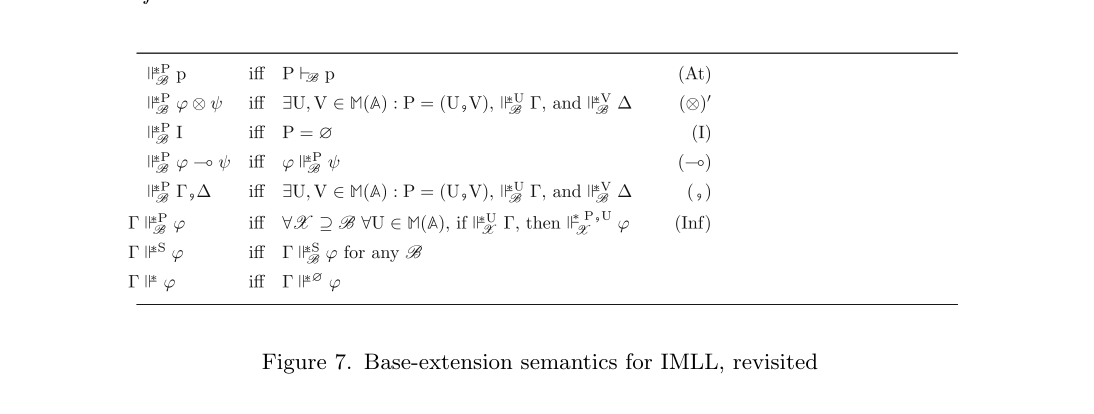
The support relation is defined inductively by the clauses of Figure 7, in which $\Gamma, \Delta \in$ M(F), p $\in$ A,P, U, V $\in$ M(A), and B, X $\in$ B. It is this notion of support that we desire to show is sound and complete for IMLL. We can recover the analogous preliminary results from Section 4 without challenge:
If $\Gamma \sforces_{B}^{P} \phi$ and $C \supseteq B$, then $\Gamma \sforces_{C}^{P} \phi$.
This argument is similar to the one for Proposition 7. As before, we proceed by induction on $\sforces$ (see Definition 15).
– base case. In this case, $\Gamma \sforces_{B}^{S} \phi$ is of the form $\sforces_{B}^{S} p$, where $p \in A$. By (At), infer $S \vdash_B p$. Since $C \supseteq B$, every rule in B is also a rule in B, so $S \vdash_C p$. By (At), conclude $\forces_{C}^{S} p$.
– inductive step. For the inductive cases (I), $(\multimap)$ (expanded using (Inf) and (,)), note that each takes an arbitrary extension of B—that is, says ‘for every $X \supseteq B$, . . . ’—so follows immediately. If the statement takes place over an arbitrary $C \subseteq B$, such extensions also holds; that is, we choose $X \supseteq C$. Therefore, the inductive steps also pass. In the remaining case of $(\otimes)'$, the result follows from the induction hypothesis. This completes the induction.
□This follows mutatis mutandis on the proof of Corollary 8 It remains to prove soundness and completeness.
□5.2 Soundness
If $\Gamma \vdash \phi$, then $\Gamma \forces \phi$. We proceed as in Sections 2 and 4; that is, by showing that support respects the inductive definition of IMLL as provided by NM. Since the clauses for $\otimes$ and, coincide, we no longer require the ancillary lemmas showing that the semantics for $\otimes$ and , are coherent (e.g., Lemma 12).
It suffices to show the following:
$$\begin{aligned} \text{(Ax)} \quad& \phi \forces \phi \\ (\multimap\text{I}) \quad& \text{If } \Gamma, \phi \forces \psi, \text{ then } \Gamma \forces \phi \multimap \psi \\ (\multimap\text{E}) \quad& \text{If } \Gamma \forces \phi \multimap \psi \text{ and } \Delta \forces \phi, \text{ then } \Gamma, \Delta \forces \psi \\ (\otimes\text{I}) \quad& \text{If } \Gamma \forces \phi \text{ and } \Delta \forces \psi, \text{ then } \Gamma, \Delta \forces \phi \otimes \psi \\ (\otimes\text{E}) \quad& \text{If } \Gamma \forces \phi \otimes \psi \text{ and } \Delta, \phi, \psi \forces \chi, \text{ then } \Gamma, \Delta \forces \chi \\ (\text{II}) \quad& \forces I \\ (\text{IE}) \quad& \text{If } \Gamma \forces \chi \text{ and } \Delta \forces I, \text{ then } \Gamma, \Delta \forces \chi \end{aligned}$$We prove each claim separately:
– (Ax). This statement is a tautology after applying (Inf), so it holds trivially.
– $(\multimap\text{I})$. Assume (1) $\Gamma, \phi \sforces \psi$, we require show (2) $\Gamma \forces \phi \multimap \psi$. Let $B \in \mathcal{B}$ and $P \in \mathcal{M}(A)$ be arbitrary such that $\sforces_B^P \Gamma$; by (Inf), (2) becomes (3) $\forces_B^P \phi \multimap \psi$. By $(\multimap)$, from (3) infer (4) $\phi \sforces_B^P \psi$. Let $C \supseteq B$ and $T \in \mathcal{M}(A)$ be arbitrary such that $\sforces_C^T \phi$; by (Inf), (4) becomes (5) $\sforces_C^{P,T} \psi$. Thus, we require to show that (1) implies (5) for bases and resource satisfying the give conditions. By Proposition 18 (monotonicity) on $\sforces_B^P \Gamma$, infer $\sforces_C^P \Gamma$. The desired result holds by (Inf) and (,) on (1).
– $(\multimap\text{E})$. Assume (1) $\Gamma \sforces \phi \multimap \psi$ and (2) $\Delta \sforces \phi$, we require to show (3) $\Gamma, \Delta \sforces \psi$. Let $B \in \mathcal{B}$ and $P \in \mathcal{M}(A)$ be arbitrary such that (4) $\sforces_B^P \Gamma, \Delta$; by (Inf), (3) becomes (5) $\sforces_B^P \psi$. Thus: we require to show that under the conditions given (e.g., (4)), (1) and (2) imply (5). By (,) on (4), $\exists P_1, P_2 \in \mathcal{M}(A)$ such that $P = P_1, P_2$, $\forces_B^{P_1} \Gamma$, and $\forces_B^{P_2} \Delta$. By (Inf) on (1) and (2), infer (6) $\sforces_B^{P_1} \phi \multimap \psi$ and (7) $\sforces_B^{P_2} \phi$. By $(\multimap)$ on (6) infer (8) $\phi \sforces_B^{P_1} \psi$. By (Inf) on (8) using (7), infer (5), as required.
– $(\otimes\text{I})$. Assume (1) $\Gamma \sforces \phi$ and (2) $\Delta \sforces \psi$, we require to show (3) $\Gamma, \Delta \sforces \phi \otimes \psi$. Let $B \in \mathcal{B}$ and $P \in \mathcal{M}(A)$ be arbitrary such that (4) $\sforces_B^P \Gamma, \Delta$; by (Inf), (3) becomes (5) $\sforces_B^P \phi \otimes \psi$. Thus, we require to show that (1) and (2) imply (5) for the given bases and resources. By (,) on (4), $\exists P_1, P_2 \in \mathcal{M}(A)$ such that (6) $\sforces_B^{P_1} \Gamma$ and (7) $\sforces_B^{P_2} \Delta$. By (Inf) on (1) and (2) using (6) and (7), respectively, infer (8) $\sforces_B^{P_1} \phi$ and (9) $\sforces_B^{P_2} \psi$. By $(\otimes)'$ using (8) and (9) infer (5), as required.
– $(\otimes\text{E})$. Assume (1) $\Gamma \sforces \phi \otimes \psi$ and (2) $\Delta, \phi, \psi \sforces \chi$, then (3) $\Gamma, \Delta \sforces \chi$. Let $B \in \mathcal{B}$ and $P \in \mathcal{M}(A)$ be arbitrary such that (4) $\sforces_B^P \Gamma, \Delta$; by (Inf), (3) becomes (5) $\sforces_B^P \chi$. Thus, we require to show that (1) and (2) imply (5) for the bases and resource given. By (,), $\exists P_1, P_2 \in \mathcal{M}(A)$ such that $P = P_1, P_2$, (6) $\sforces_B^{P_1} \Gamma$, and (7) $\sforces_B^{P_2} \Delta$. By (Inf) on (1) using (6) infer (8) $\sforces_B^{P_1} \phi \otimes \psi$. By $(\otimes)'$ and (,), infer (9) $\sforces_B^{P_1} \phi, \psi$. By (,) on (7) and (9), infer (10) $\sforces_B^P \Delta, \phi, \psi$. By (Inf) on (2) using (10), infer (5), as required.
– (II). By $(\multimap)$, $\sforces_B^\emptyset I$ for any $B \in \mathcal{B}$. This is precisely $\sforces I$.
– (IE). Assume (1) $\Gamma \sforces \chi$ and (2) $\Delta \sforces I$, then (3) $\Gamma, \Delta \sforces \chi$. Let $B \in \mathcal{B}$ and $P \in \mathcal{M}(A)$ be arbitrary such that (4) $\sforces_B^P \Gamma, \Delta$; by (Inf), (3) becomes (5) $\sforces_B^P \chi$. Thus, we require to show that (1) and (2) imply (5) for the given base and resources. By (,) on (4), $\exists P_1, P_2 \in \mathcal{M}(A)$ such that $P = P_1, P_2$, (6) $\sforces_B^{P_1} \Gamma$, and (7) $\sforces_B^{P_2} \Delta$. By (Inf) on (1) and (2) using (6) and (7), respectively, infer (8) $\sforces_B^{P_1} \chi$ and (9) $\sforces_B^{P_2} I$. By (I) on (9), $P_2 = \emptyset$; hence, $P = P_1$. Thus (8) is (5), which is the required result.
This completes the case analysis.
□5.3 Completeness
If $\Gamma \sforces \phi$, then $\Gamma \vdash \phi$.
Fix a sequent $\Gamma \rhd \phi$ and let $\Xi$ be the set of sub-formulae. Fix a denumerable set of fresh atoms B—that is, $B \cap A = \emptyset$—and an injection $(\cdot)^\flat : \Xi - A \to B$ and extend it to $(\cdot)^\flat : \Xi \to B$ with identity on A. Let $(\cdot)^\natural$ be the left-inverse of $(\cdot)^\flat$—that is, $$p^\natural := \begin{cases} \chi & \text{if } \chi^\flat = p \\ p & \text{otherwise} \end{cases}$$ Both act on multisets of formulae pointwise; that is, $$\Delta^\flat := [\delta^\flat \mid \delta \in \Delta] \quad\text{and}\quad P^\natural := [p^\natural \mid p \in P]$$ The point of B is to isolate elements of $\Xi$ when moving from support to derivability in a base. Crucially, bases and support are defined over A, not $A \cup B$. Therefore, to enable simulation, we require an auxiliary notion of derivability in a base that incorporates both the uses of the base to handle A and simulates NM for B. This is the major point of departure from the previous completeness proofs in this paper. Note that the auxiliary notion of derivability in a base is dependent on the choice of $\Gamma \rhd \phi$, B, and $(\cdot)^\flat$.
Let $\Gamma \rhd \phi$, B, $(\cdot)^\flat$ be fixed. Let $B \in \mathcal{B}$. The auxiliary derivability-in-B relation $\svdash_B \subseteq \mathcal{M}(A \cup B) \times (A \cup B)$ is the smallest relation satisfying the following conditions (when well-defined): $\forall S, T \subseteq \mathcal{M}(A)\ \forall p \in A\ \forall \phi, \psi, \chi \in \Xi \cup A$,
- ref. $p \svdash_B p$
- app. If $S_i, P_i \svdash_B p_i$ for $i = 1, \ldots, n$ and $(P_1 \rhd p_1, \ldots, P_n \rhd p_n) \Rightarrow p \in B$, then $S_1, \ldots, S_n \svdash_B p$.
- $(\multimap_B^{\text{I}})$. If $S, \phi^\flat \svdash_B \psi^\flat$, then $S \svdash_B (\phi \multimap \psi)^\flat$.
- $(\multimap_B^{\text{E}})$. If $S \svdash_B \phi^\flat$ and $T \svdash_B (\phi \multimap \psi)^\flat$, then $S, T \svdash_B \psi^\flat$.
- $(\otimes_B^{\text{I}})$. If $S \svdash_B \phi^\flat$ and $S \svdash_B \psi^\flat$, then $S \svdash_B (\phi \otimes \psi)^\flat$.
- $(\otimes_B^{\text{E}})$. If $S \svdash_B (\phi \otimes \psi)^\flat$ and $T, \phi^\flat, \psi^\flat \svdash_B \chi^\flat$, then $S, T \svdash_B \chi^\flat$.
- $(I_B^{\text{I}})$. $\svdash_B I^\flat$.
- $(I_B^{\text{E}})$. If $S \svdash_B \chi^\flat$ and $T \svdash_B I^\flat$, then $S, T \svdash_B \chi^\flat$.
Let $p, q, r, s \in A$ and $x \in B$. Suppose $\Gamma = [p, q]$ and $\phi = (p \otimes q)$, and define $(p \otimes q)^\flat = x$ accordingly. By $\otimes_B^{\text{I}}$, for any $B \in \mathcal{B}$, including $B = \emptyset$, we have $p, q \svdash_B x$. This auxiliary notion of derivability in a base allows us to establish an appropriate version of Lemma 14 for this semantics.
For any $S \in \mathcal{M}(A)$, and $\xi \in \Xi$, $$S \svdash_B (\xi_1 \multimap \xi_2)^\flat \quad\text{iff}\quad \xi_1^\flat, S \svdash_B \xi_2^\flat$$
The right-to-left direction obtains immediately by $\multimap_B^{\text{I}}$ in Definition 16. For the left-to-right observe that $\xi_1^\flat \svdash_B \xi_1^\flat$ obtains by ref in Definition 16; the desired result follows $\multimap_B^{\text{E}}$ using the hypothesis.
□For any $S \in \mathcal{M}(A)$, and $\xi \in \Xi$, $$S \svdash_B (\xi_1 \otimes \xi_2)^\flat \quad\text{iff}\quad \exists U, V \in \mathcal{M}(A) : S = (U, V),\ U \svdash_B \xi_1^\flat,\ \text{and } V \svdash_B \xi_2^\flat$$
The right-to-left direction obtains by $\otimes_B^{\text{I}}$. It remains to consider the left-to-right direction.
While Definition 16 has been given inductively as closure conditions of the relations $\svdash_{-}$, we assume its correspondence to natural deduction to make the proofs of the required propositions is self-evident. Let D be a derivation witnessing $S \svdash_B (\xi_1 \otimes \xi_2)^\flat$. If the last rule used in D is $\otimes\text{I}^\flat$, then we are done. Therefore, it suffices to show that such a derivation always exists. Suppose the given D does not conclude by $\otimes\text{I}^\flat$, then we transform D such that it is the case. To this end, we require some preliminary observations about the structure of D:
– Since $(\xi_1 \otimes \xi_2)^\flat \in B$ and ref in Definition 16 only applies to A the derivation D uses at least one instance of a condition that is not ref;
– At some point $\otimes_B^{\text{I}}$ is used to conclude $(\xi_1 \otimes \xi_2)^\flat$ as it is the only condition that can do so without the formula being a premiss or an assumption (e.g., in $\otimes_B^{\text{E}}$);
– Since $(\xi_1 \otimes \xi_2)^\flat \in B$ and the rules in B all conclude with an element of A, the last condition used must be of the auxillary closure conditions;
– The closure conditions that can conclude $(\xi_1 \otimes \xi_2)^\flat$ are $\otimes_B^{\text{I}}$, $\otimes_B^{\text{E}}$, $I_B^{\text{E}}$, $\multimap_B^{\text{E}}$.
Henceforth, we shall call the ‘closure conditions’ rules as we take the natural deduction perspective; the natural deduction proofs represent a trace through Definition 16. The height h of D is the number of nodes it contains; this corresponds to the total number of times a closure condition is used to witness the judgement. We proceed by induction on h to establish that there is a derivation concluding $(\xi_1 \otimes \xi_2)^\flat$ from S by $\otimes_B^{\text{I}}$:
– base case. $h = 1$. We are done as D must conclude by an instance of $\otimes_B^{\text{I}}$.
– inductive step. $h > 1$. If D concludes by $\otimes_B^{\text{I}}$, then we are done. Otherwise, following the observations above, it concludes by one of $\otimes_B^{\text{I}}$, $\otimes_B^{\text{E}}$, $I_B^{\text{E}}$, $\multimap_B^{\text{E}}$. We proceed by case analysis to replace D with a derivation $D'$ that has the same open assumptions and conclusion but concludes by $\otimes_B^{\text{I}}$.
To simplify matters, we eliminate the case in which D ends by $\multimap_B^{\text{E}}$. In this case, the given D is of the following form, with $S = S_1, S_2$: $$\dfrac{\dfrac{S_1}{\varepsilon^\flat}\,{\scriptstyle(D_1)} \qquad \dfrac{S_2}{(\varepsilon \multimap (\xi_1 \otimes \xi_2))^\flat}\,{\scriptstyle(D_2)}}{(\xi_1 \otimes \xi_2)^\flat}\,{\multimap}\text{E}$$ Observe that $D_2$ witnesses $S_2 \svdash_B (\varepsilon \multimap (\xi_1 \otimes \xi_2))^\flat$. By Proposition 22, infer $\varepsilon^\flat, S_2 \svdash_B (\xi_1 \otimes \xi_2)^\flat$. Let $D'_2$ be a derivation witnessing this judgement, $$\dfrac{\varepsilon^\flat, S_2}{(\xi_1 \otimes \xi_2)^\flat}\,{\scriptstyle(D'_2)}$$ We can remove the instance of $\multimap_B^{\text{I}}$ in D by composing $D_1$ with $D'_2$ to yield $D''_2$, $$\dfrac{S_1, S_2}{(\xi_1 \otimes \xi_2)^\flat}\,{\scriptstyle(D''_2)}$$ Importantly, $D''_2$ has strictly fewer such instance of $\multimap_B^{\text{I}}$ (reading upward) until another rule is used that concludes $(\varepsilon \multimap (\xi_1 \otimes \xi_2))^\flat$. Therefore, without loss of generality, we can assume that the given D does not conclude by $\multimap_B^{\text{I}}$.
It remains to consider the cases where it concludes by $\otimes_B^{\text{E}}$ and $I_B^{\text{E}}$. The transformations are as follows:
– $\otimes_B^{\text{E}}$. By the induction hypothesis (IH), the sub-derivation of the premisses both end by $\otimes_B^{\text{I}}$; that is, D is of the following form, where $\varepsilon_1^\flat, \varepsilon_2^\flat, S = S_1, S_2, S_3, S_4$: $$\dfrac{\dfrac{\dfrac{S_1}{\varepsilon_1^\flat}\,{\scriptstyle(D_1)} \quad \dfrac{S_2}{\varepsilon_2^\flat}\,{\scriptstyle(D_2)}}{(\varepsilon_1 \otimes \varepsilon_2)^\flat}\,{\otimes}\text{I} \qquad \dfrac{\dfrac{S_3}{\xi_1^\flat}\,{\scriptstyle(D_3)} \quad \dfrac{S_4}{\xi_2^\flat}\,{\scriptstyle(D_4)}}{(\xi_1 \otimes \xi_2)^\flat}\,{\otimes}\text{I}}{(\xi_1 \otimes \xi_2)^\flat}\,{\otimes}\text{E}$$ By definition of $\otimes_B^{\text{E}}$, we have $\varepsilon_1^\flat, \varepsilon_2^\flat \in S_3, S_4$. There are four possible distributions of $\varepsilon_1^\flat$ and $\varepsilon_2^\flat$ in $S_3, S_4$—namely: one, $\varepsilon_1^\flat, \varepsilon_2^\flat \in S_3$; two, $\varepsilon_1^\flat, \varepsilon_2^\flat \in S_4$; three, $\varepsilon_1^\flat \in S_3$ and $\varepsilon_2^\flat \in S_4$; four, $\varepsilon_1^\flat \in S_4$ and $\varepsilon_2^\flat \in S_3$. We illustrate case one and four, the others following by symmetry.
– One. If $\varepsilon_1^\flat, \varepsilon_2^\flat \in S_3$, let $D'_3$ be the result of composing $D_1$ and $D_2$ with $D_3$. Let $S'_3 = S_3 - \varepsilon_1^\flat, \varepsilon_2^\flat$. The desired $D'$ is as follows: $$\dfrac{\dfrac{S_1, S_2, S'_3}{\xi_1^\flat}\,{\scriptstyle(D'_3)} \qquad \dfrac{S_4}{\xi_2^\flat}\,{\scriptstyle(D_4)}}{(\xi_1 \otimes \xi_2)^\flat}\,{\otimes}\text{I}$$
– Two. If $\varepsilon_1^\flat \in S_3$ and $\varepsilon_2^\flat \in S_4$. Let $D'_3$ and $D'_4$ be the results of composing $D_1$ and $D_2$ with $D_3$ and $D_4$, respectively. Let $S'_3 = S_3 - \varepsilon_1^\flat$ and $S'_4 = S_4 - \varepsilon_1^\flat, \varepsilon_2^\flat$. The desired $D'$ is as follows: $$\dfrac{\dfrac{S_1, S'_3}{\xi_1^\flat}\,{\scriptstyle(D'_3)} \qquad \dfrac{S_2, S'_4}{\xi_2^\flat}\,{\scriptstyle(D'_4)}}{(\xi_1 \otimes \xi_2)^\flat}\,{\otimes}\text{I}$$ This completes the case analysis.
– $I_B^{\text{E}}$. By the IH, the sub-derivation ending with $(\xi_1 \otimes \xi_2)^\flat$ conclude by $\otimes\text{I}$; that is, D is of the following form, where $S = S_1, S_2, S_3$: $$\dfrac{\dfrac{\dfrac{S_1}{\xi_1^\flat}\,{\scriptstyle(D_1)} \quad \dfrac{S_2}{\xi_2^\flat}\,{\scriptstyle(D_2)}}{(\xi_1 \otimes \xi_2)^\flat}\,{\otimes}\text{I} \qquad \dfrac{S_3}{I^\flat}\,{\scriptstyle(D_3)}}{(\xi_1 \otimes \xi_2)^\flat}\,I_B\text{E}$$ The desired $D'$ obtains by permuting the rules in either one of the two possible ways—for example, $$\dfrac{\dfrac{\dfrac{S_1}{\xi_1^\flat}\,{\scriptstyle(D_1)} \quad \dfrac{S_3}{I^\flat}\,{\scriptstyle(D_3)}}{\xi_1^\flat}\,I_B\text{E} \qquad \dfrac{S_2}{\xi_2^\flat}\,{\scriptstyle(D_2)}}{(\xi_1 \otimes \xi_2)^\flat}\,{\otimes}\text{I}$$ This completes the case analysis. This completes the induction.
□Let B $\in$ B be arbitrary and P $\in$ M(A),
$$P \svdash_B I^\flat \text{ iff } P = \emptyset.$$The right-to-left obtains by $\multimap_B^{\text{I}}$ in Definition 16. The left-to-right proceeds as a simplified version of the proof of Proposition 23, because I is the unit of $\otimes$.
Observe that $\vdash_B$ and $\svdash_B$ are identical when restricted to A—that is, $S \vdash_B p$ iff $S \svdash_B p$ for $S, p \in \mathcal{M}(A)$. The elements of B are used as an intermediate step that moves us from the semantics of complex formulae (i.e., formulae in $\mathcal{F} - A$) to atomic formulae (i.e., formulae in A). To enable this shift we also use an auxiliary notion of support that is grounded in the auxiliary notion of derivability in a base.
□Let $\ssforces_{-}^{-}$ have the clauses in Figure 7, which define $\sforces_{-}^{-}$, but with $\vdash_{-}$ replaced with $\svdash_{-}$—that is, (At) is replaced by the following: $$\ssforces_B^P p \quad\text{iff}\quad P \svdash_B p \tag{At$'$}$$ For clarity, quantification in the clauses defining $\ssforces_{-}^{-}$ takes place over A and M(A) and bases are over A, not over $A \cup B$. For example, the clause for $\otimes$ is $$\sforces_B^P \phi \otimes \psi \quad\text{iff}\quad \exists U, V \in \mathcal{M}(A) : P = (U, V),\ \sforces_B^U \Gamma,\ \text{and } \sforces_B^V \Delta \tag{$\otimes'$}$$ not $$\sforces_B^P \phi \otimes \psi \quad\text{iff}\quad \exists U, V \in \mathcal{M}(A \cup B) : P = (U, V),\ \sforces_B^U \Gamma,\ \text{and } \sforces_B^V \Delta \tag{$\otimes'$}$$ This auxillary support relation enable us to prove the key lemmas delivering completeness:
– IMLL-AtComp$'$. For any $B, P, S \in \mathcal{M}(A \cup B)$, and $q \in A \cup B$, $P, S \svdash_B q$ iff $P \ssforces_B^S q$.
– IMLL-Flat$'$. For any $\xi \in \Xi$, base X and $U \in \mathcal{M}(A)$, $$\ssforces_X^U \xi^\flat \quad\text{iff}\quad \sforces_X^U \xi$$
– IMLL-Nat$'$. For any $P \in \mathcal{M}(A \cup B)$ and $p \in A \cup B$: if $P \svdash_\emptyset p$, then $P^\natural \vdash p^\natural$.
Proof of Theorem 21 — Completeness. Assume $\Gamma \sforces \phi$ and let $B$, $(\cdot)^\flat$, and $\svdash$ be as described. By IMLL-Flat$'$ and (Inf), infer $\Gamma^\flat \ssforces_\emptyset^\emptyset \phi^\flat$. Therefore, by IMLL-AtComp, we have $\Gamma^\flat \svdash_\emptyset \phi^\flat$. Finally, by IMLL-Nat, $\left(\Gamma^\flat\right)^\natural \vdash \left(\phi^\flat\right)^\natural$—that is, $\Gamma \vdash \phi$.
For any base B, $P, S \in \mathcal{M}(A \cup B)$, and $p \in A \cup B$, $$P, S \svdash_B p \quad\text{iff}\quad P \ssforces_B^S p$$
This is the same as for the proof of IMLL-AtComp as it only concerns the base case of the relation and (Inf).
□For any $\xi \in \Xi$, $X \in \mathcal{B}$, and $U \in \mathcal{M}(A)$, $$\ssforces_X^U \xi^\flat \quad\text{iff}\quad \sforces_X^U \xi$$
Fix an arbitrary $B \in \mathcal{B}$ and $P \in \mathcal{M}(A)$. We proceed by case analysis on the structure of $\xi$:
– $\xi$ is atomic. This follows from (At) and (At)$'$ by observing that $P \vdash_B p$ iff $P \svdash_B p$.
– $\xi$ is I. $$\begin{array}{ll} & \ssforces_B^P I^\flat \\ \text{iff} & P \svdash_B I^\flat \quad (\text{IMLL-AtComp}') \\ \text{iff} & P = \emptyset \quad (\text{Proposition 24}) \\ \text{iff} & \sforces_B^P I^\flat \quad (\text{I}) \end{array}$$
– $\xi$ is of the form $\xi_1 \multimap \xi_2$. $$\begin{array}{ll} & \ssforces_B^P (\xi_1 \multimap \xi_2)^\flat \\ \text{iff} & P \svdash_B (\xi_1 \multimap \xi_2)^\flat \quad (\text{IMLL-AtComp}') \\ \text{iff} & P, \xi_1^\flat \svdash_B \xi_2^\flat \quad (\text{Proposition 22}) \\ \text{iff} & \xi_1^\flat \ssforces_B^P \xi_2^\flat \quad (\text{IMLL-AtComp}') \\ \text{iff} & \xi_1^\flat \sforces_B^P \xi_2^\flat \quad (\text{IH}) \end{array}$$
– $\xi$ is of the form $\xi_1 \otimes \xi_2$. $$\begin{array}{ll} & \ssforces_B^P (\xi_1 \otimes \xi_2)^\flat \\ \text{iff} & P \svdash_B (\xi_1 \otimes \xi_2)^\flat \quad (\text{IMLL-AtComp}') \\ \text{iff} & \exists U, V \in \mathcal{M}(A) : P = (U, V),\ U \svdash_B \xi_1^\flat,\ \text{and } V \svdash_B \xi_2^\flat \quad (\text{Proposition 23}) \\ \text{iff} & \exists U, V \in \mathcal{M}(A) : P = (U, V),\ \ssforces_B^U \xi_1^\flat,\ \text{and } \ssforces_B^V \xi_2^\flat \quad (\text{IMLL-AtComp}) \\ \text{iff} & \exists U, V \in \mathcal{M}(A) : P = (U, V),\ \sforces_B^U \xi_1,\ \text{and } \sforces_B^V \xi_2 \quad (\text{IH}) \\ \text{iff} & \sforces_B^S \xi_1 \otimes \xi_2 \quad (\otimes') \end{array}$$
The (IH) refers to the induction hypothesis. This completes the induction.
□For any $P \in \mathcal{M}(A \cup B)$ and $p \in A \cup B$: if $P \svdash_\emptyset p$, then $P^\natural \vdash p^\natural$.
This follows immediately from the fact that the defining conditions of $\svdash_{-}$ exactly simulate the rules defining $\vdash$ after $-^\natural$ has been applied.
□6 Category-theoretic Interpretation
Pym et al. (2023, 2024) [43,44] initiated the integration of P-tS into category-theoretic logic. They concentrated on the original B-eS for IPL by Sandqvist [46]: they provided a sound and complete interpretation within a presheaf category, demonstrating the formal naturality of the constructions—that is, interpreting formulae as functors, support in a base is interpreted as a natural transformation. By considering associated sheaf categories, they also established topological characterizations of possible interpretations of disjunction. In this section, we adopt a similar approach, providing a category-theoretic interpretation of the B-eS for IMLL as introduced in Section 4. Our category-theoretic semantics for IMLL relies on symmetric monoidal categories (SMCs) —see, for example, [5] on categorical models of intuitionistic linear logic. We assume familiarity with SMCs—see, for example, [11,33] for further details.
Before delving into technical details, we establish some intuitions. We interpret each IMLL formula as a presheaf—that is, a functor of the form $\mathbb{W}^{op} \to \mathbf{Set}$. The category $\mathbb{W}$ (see Definition 21) represents bases and multisets of atoms. In this context, the functor corresponding to the formula $\varphi$ at $\langle \mathcal{B}, P\rangle$ in $\mathbb{W}$ corresponds to the judgment $\Vdash_{\mathcal{B}}^{P} \varphi$. The monoidal structure on these presheaves is derived from that of $\mathbb{W}$ using the celebrated Day convolution or Day product [9]. Its importance in this work merits some elaboration.
6.1 Background: Day’s Convolution
Let V be an SMC with all small limits and colimits, and let C be an arbitrary V-enriched category. Day [9] presents a general method for constructing a monoidal closed structure on the (V-enriched) functor category [C, V]. These monoidal structures $\otimesDay$ are called Day convolution or Day product. In this paper, V is Set, the category of sets. The Day product $\otimesDay$ and its adjoint $\toDay$ will be deployed to interpret $\,,\,$ (though not precisely $\otimes$ due to its nonstandard semantic clause $(\otimes)$) and $\multimap$, respectively. That is, let $\langle \mathbb{C}, \otimes, I\rangle$ be a (small) SMC, then (by Day’s construction), we have a SMC structure on the presheaf category $\widehat{\mathbb{C}}$ (i.e., $[\mathbb{C}^{op}, \mathbf{Set}]$). One way to understand Day’s construction is as a (co)end. We refer to Loregian [31] for an introduction to (co)end calculus, and only sketch the necessary definitions and notations.
Let $\mathcal{F} : \mathbb{X}^{op} \times \mathbb{X} \to \mathbb{Y}$ be a functor. A wedge for $\mathcal{F}$ is an object $w : e \Rightarrow \mathcal{F}$ that consists of a $\mathbb{Y}$-object e and a family of $\mathbb{Y}$-morphisms $w_x : e \to \mathcal{F}(x, x)$ such that, for any $\mathbb{X}$-morphism $f : x \to x'$, the following diagram commutes: $$\begin{array}{ccc} e & \xrightarrow{\;w_x\;} & \mathcal{F}(x, x) \\ {\scriptstyle w_{x'}}\downarrow & & \downarrow{\scriptstyle \mathcal{F}(id_x, f)} \\ \mathcal{F}(x', x') & \xrightarrow{\;\mathcal{F}(f, id_{x'})\;} & \mathcal{F}(x, x') \end{array}$$ A cowedge is the dual notion of a wedge.
Let $\mathcal{F} : \mathbb{X}^{op} \times \mathbb{X} \to \mathbb{Y}$ be a functor. The end for $\mathcal{F}$ is a universal wedge—that is, a wedge w such that any other wedge $w' : e' \Rightarrow \mathcal{F}$ factors through w by some unique $\mathbb{Y}$-morphism $f : e' \to e$. It is denoted as $\int_{x:\mathbb{X}} \mathcal{F}(x, x)$, and equipped with a universal extranatural transformation $\pi : \int_{x:\mathbb{X}} \mathcal{F}(x, x) \Rightarrow \mathcal{F}$. A cowedge is the dual notion of a wedge, and a coend is the dual notion of an end; that is, a universal cowedge. It is denoted $\int^{x:\mathbb{X}} \mathcal{F}(x, x)$ and comes equipped with a universal extranatural transformation $\iota : \mathcal{F} \Rightarrow \int^{x:\mathbb{X}} \mathcal{F}(x, x)$. A useful alternative statement of the above definition of ends is in terms of equalizers: $$\int_{x:\mathbb{X}} \mathcal{F}(x, x) \xrightarrow{\;\pi\;} \prod_{x \in \mathbb{X}} \mathcal{F}(x, x) \underset{\rho}{\overset{\lambda}{\rightrightarrows}} \prod_{(u \xrightarrow{f} v) \in \mathbb{X}} \mathcal{F}(u, v) \tag{4}$$ Here, $\lambda$ and $\rho$ are the ‘left’ and ‘right’ actions respectively; at each $f : u \to v$, the f-th component of $\lambda$ and $\rho$, say $\lambda_f, \rho_f : \prod_{x \in \mathbb{X}} \mathcal{F}(x, x) \to \mathcal{F}(u, v)$, are defined as follows:
– $\lambda_f(t) = \mathcal{F}(f, v)(t_v)$
– $\rho_f(t) = \mathcal{F}(u, f)(t_u)$ The end, as an equalizer, then collects all those tuples in $\prod_x \mathcal{F}(x, x)$ on which the left and right actions coincide. Dually, coends are coequalizers: $$\prod_{(u \xrightarrow{f} v) \in \mathbb{X}} \mathcal{F}(v, u) \underset{\rho'}{\overset{\lambda'}{\rightrightarrows}} \prod_{x \in \mathbb{X}} \mathcal{F}(x, x) \xrightarrow{\;\iota\;} \int^{x:\mathbb{X}} \mathcal{F}(x, x) \tag{5}$$
One elementary example of ends is the end presentation of natural transformations. Given functors $\mathcal{F}, \mathcal{G} : \mathbb{C} \to \mathbb{D}$, one has $[\mathbb{C},\mathbb{D}](\mathcal{F}, \mathcal{G}) \cong \int_{x:\mathbb{C}} \mathbb{D}(\mathcal{F}x, \mathcal{G}x)$. Use (4), one can spell out the end concretely as equalizers, so elements in $\int_{x:\mathbb{C}} \mathbb{D}(\mathcal{F}x, \mathcal{G}x)$ are precisely those families of $\mathbb{D}$-morphisms $\{\sigma_x : Fx \to Gx\}_{x \in C}$ such that the following diagram commutes for arbitrary f : x $\to$ y: $$\begin{array}{ccc} \mathcal{F}x & \xrightarrow{\;\sigma_x\;} & \mathcal{G}x \\ {\scriptstyle \mathcal{F}f}\downarrow & & \downarrow{\scriptstyle \mathcal{G}f} \\ \mathcal{F}y & \xrightarrow{\;\sigma_y\;} & \mathcal{G}y \end{array}$$ This is exactly the defining naturality condition for natural transformations. Let $\mathbf{よ}$ denote the Yoneda embedding; that is, $\mathbf{よ}(c) = \mathbb{C}(-, c)$, and $\mathbf{よ}(c \xrightarrow{f} d) = \mathbb{C}(-, f)$. The symbol ‘$\mathbf{よ}$’ is a hiragana character pronounced ‘Yo’. It was first used by Johnson-Freyd and Scheimbauer [26] to denote the Yoneda embedding. Day’s Construction. The SMC structure on $\widehat{\mathbb{C}}$ is defined as follows:
– The monidal product $\otimes$ is the Day product $\otimesDay$: for any $\mathcal{F}, \mathcal{G} : \mathbb{C}^{op} \to \mathbf{Set}$ and $c \in \mathbb{C}$, $$(\mathcal{F} \otimesDay \mathcal{G})(c) = \int^{x_1, x_2 : \mathbb{C}} \mathcal{F}(x_1) \times \mathcal{G}(x_2) \times \mathbb{C}(c, x_1 \otimes x_2) \tag{6}$$
– The monoidal unit for $\otimesDay$ is $\mathbf{よ}I$
– The internal hom is the adjoint $\toDay$ of $\otimesDay$: for any $\mathcal{F}, \mathcal{G} : \mathbb{C}^{op} \to \mathbf{Set}$ and $c \in \mathbb{C}$, $$(\mathcal{F} \toDay \mathcal{G})(c) = \int_{x:\mathbb{C}} \mathbf{Set}(\mathcal{F}(x), \mathcal{G}(c \otimes x)) \cong \widehat{\mathbb{C}}(\mathcal{F}, \mathcal{G}(c \otimes -)) \tag{7}$$ We provide some intuition on the use of (co)ends above:
– As a coend, $(\mathcal{F} \otimesDay \mathcal{G})(c)$ are equivalence classes of triples in $\mathcal{F}(x_1)\times \mathcal{G}(x_2) \times \mathbb{C}(c, x_1 \otimes x_2)$. They are thought of as pairs (A, B) in $\mathcal{F}(x_1) \times \mathcal{G}(x_2)$ such that $x_1$ and $x_2$ ‘cover’ of c—that is, there is a $\mathbb{C}$-morphism $c \to x_1 \otimes x_2$
– The $\cong$ in (7) applies the end presentation of natural transformations from Example 4
– $(\mathcal{F} \toDay \mathcal{G})(c)$ is (up to isomorphism) all the natural transformations of the form $\mathcal{F} \Rightarrow \mathcal{G}\circ (c\otimes-)$. The $(c\otimes-)$ in the target functor models a ‘contextual’ resource c in the sense of IMLL—that is, a function that, given a resource, returns that resource composed with the resource c. The following fact turns out to be useful when commuting this ‘contextual’ resource $(c \otimes -)$.
$$\mathcal{G} \toDay (\mathcal{H}(c \otimes -)) \cong (\mathcal{G} \toDay \mathcal{H})(c \otimes -)$$
Both the LHS and RHS are equivalent to $$\int_{x:\mathbb{C}} \mathbf{Set}\Big(\mathcal{G}(x), \mathcal{H}(x \otimes c \otimes -)\Big).$$
□We give a simple example of the Day product on $\mathbb{N}$, where $\mathbb{N}$ is the discrete category of natural numbers, equipped with the monoidal structure $\langle +, 0\rangle$. Given two functors $\mathcal{F}, \mathcal{G} : \mathbb{N}^{op} \to \mathbf{Set}$ (note that $\mathbb{N}^{op}$ is exactly $\mathbb{N}$ due to discreteness), their Day product is $$\mathcal{F} \otimesDay \mathcal{G} : (n \in \mathbb{N}) \to \sum_{i,j \in \mathbb{N}} \mathcal{F}(i) \times \mathcal{G}(j) \times \mathbb{N}(n, i + j) = \coprod_{i,j : i+j=n} \mathcal{F}(i) \times \mathcal{G}(j)$$ where $\coprod$ is the disjoint union.
6.2 Formulae as Preasheves
Having given the relevant background and established some intuition, we are ready to start our constructions of a category-theoretic presentation of the B-eS of IMLL. To begin, we define the category of worlds; this is the domain of the functor spaces in which formulae are interpreted.
A context is a finite list of variable-type pairs of the form $x_1 : p_1, ..., x_m : p_m$ in which each $x_i$ is a variable, and $p_i$ is an atom (seen as a type).
We adopt the standard convention—see, for example, Jacobs [25]—that variables in contexts are listed in order $x_1$, $x_2$, ..., and concatenation of two contexts $x_1 : p_1, ..., x_m : p_m$ and $x_1 : q_1, ..., x_n : q_n$ requires accumulation of the variable indices: $$x_1 : p_1,\, ...,\, x_m : p_m,\, x_{m+1} : q_1,\, ...,\, x_{m+n} : q_n$$ Since the variable orders are fixed, once the length of the context is given, we may simply denote a context by the list of types, which we also write as P, Q,... with a bit abuse of notation. Indeed, we will use P for both a context and for the multiset of atoms to which it corresponds. This is because every list determines a multiset by forgetting the ordering, and all the lists obtained from a given multiset by assigning different orders are isomorphic, up to which we view as equivalent from a category-theoretic perspective. Hence, we use , for both the concatenation of a context and for the concatenation of lists of atoms. Moreover, henceforth, we use the term ‘context’ both in the sense of Definition 20 and in the sense of a multiset of atoms.
The category of worlds $\mathbb{W}$ has the following components:
– The objects are pairs $\langle \mathcal{B}, P\rangle$, where $\mathcal{B}$ is a base, and P is a context
– A morphism $\langle \mathcal{C}, Q\rangle$ to $\langle \mathcal{B}, P\rangle$ (where $P = p_1\,,\, ...\,,\, p_m$) is given by an inclusion $\mathcal{C} \supseteq \mathcal{B}$ and an m-tuple of derivations $(\Phi_1, ..., \Phi_m)$ in $\mathcal{C}$ of the form $Q_i \vdash_{\mathcal{C}} \Phi_i : p_i$ for each $i = 1, ..., m$, where $Q_1\,,\, ...\,,\, Q_m = Q$. For each object $\langle \mathcal{B}, P\rangle$, its identity morphism is witnessed by $\mathcal{B} \supseteq \mathcal{B}$ and $x_1 : p_i \vdash_{\mathcal{B}} x_1 : p_i$ for each (occurrence of) $p_i$ in $P_i$.
– Composition of morphisms is defined by the transitivity of base inclusion and substitution of derivations. That is, given two morphisms $\langle \mathcal{D}, R\rangle \to \langle \mathcal{C}, Q\rangle$ and $\langle \mathcal{C}, Q\rangle \to \langle \mathcal{B}, P\rangle$, say $\langle \mathcal{D} \supseteq \mathcal{C}, (\Psi_1, ..., \Psi_n)\rangle$ and $\langle \mathcal{C} \supseteq \mathcal{B}, (\Phi_1, ..., \Phi_m)\rangle$ respectively, their composite morphism is $$\langle \mathcal{D} \supseteq \mathcal{B}, (\Phi_1, ..., \Phi_m)[\Psi_1/x_1, ..., \Psi_n/x_n]\rangle$$ In other words: there is a morphism $\langle \mathcal{C}, Q\rangle$ to $\langle \mathcal{B}, P\rangle$ if $\mathcal{C}$ extends $\mathcal{B}$ and in $\mathcal{C}$, there are derivations of P from Q; that is, there is a partition $Q = Q_1\,,\,...\,,\,Q_m$ and derivations $Q_i \vdash_{\mathcal{C}} p_i$ for all $i = 1, ..., m$.
It is easy to give $\mathbb{W}$ a symmetric monoidal structure. By Day’s construction, this induces a SMC structure on $\widehat{\mathbb{W}}$, which is used for interpreting IMLL formulae.
The symmetric monoidal category of worlds $\langle \mathbb{W}, \bullet, I\rangle$, where
– the monoidal tensor $\bullet$ is defined on objects by $$\langle \mathcal{B}, P\rangle \bullet \langle \mathcal{B}', P'\rangle := \langle \mathcal{B} \cup \mathcal{B}', (P \,,\, P')\rangle$$ and on morphisms by $$\langle \mathcal{C} \supseteq \mathcal{B}, (\Phi_1, ..., \Phi_m)\rangle \bullet \langle \mathcal{C}' \supseteq \mathcal{B}', (\Phi'_1, ..., \Phi'_{m'})\rangle := \langle \mathcal{C} \cup \mathcal{C}' \supseteq \mathcal{B} \cup \mathcal{B}', (\Phi_1, ..., \Phi_m, \Phi'_1, ..., \Phi'_{m'})\rangle$$
– the monoidal unit I is defined by $I := \langle \emptyset, \emptyset\rangle$—that is, the pair of the empty base and the empty context. The symmetry $\langle \mathcal{B}, P\rangle \bullet \langle \mathcal{B}', P'\rangle \to \langle \mathcal{B}', P'\rangle \bullet \langle \mathcal{B}, P\rangle$ is simply swapping of variables.
Observe that $\bullet$ is not cartesian—for example, it lacks canonical projections.
We desire to interpret every IMLL formula $\varphi$ as a presheaf of the form $\llbracket\varphi\rrbracket : \mathbb{W}^{op} \to \mathbf{Set}$. Intuitively, at a world $\langle \mathcal{B}, P\rangle$, the value $\llbracket q\rrbracket(\langle \mathcal{B}, P\rangle)$ is the set of all derivations of q in $\mathcal{B}$ using resources P. For complex formulae, $\llbracket\varphi\rrbracket$ is defined by mimicking the clauses of the connectives (see Figure 5) in category-theoretic terms. Crucially, the functor $\forall_{\mathbb{A}}$ defined below plays the role of ‘for all $p \in \mathbb{A}$’. As in standard practice of categorical logic (see, for example, Jacobs [25]), it is obtained as the right adjoint for the functor that ‘forgets’ the variable to be universally quantified over, which simulates the $\forall$-introduction rule in first-order logic.
Let the free-variable functor $\Delta_{\mathbb{A}} : [\mathbb{W}^{op}, \mathbf{Set}] \to [\mathbb{W}^{op} \times \mathbb{A}, \mathbf{Set}]$ be defined by composing the projection on the first component with $\mathcal{F}$; that is, if $\pi_1 : \mathbb{W}^{op} \times \mathbb{A} \to \mathbb{W}^{op}$ is the projection, then $$\Delta_{\mathbb{A}}(\mathbb{W}^{op} \xrightarrow{\mathcal{F}} \mathbf{Set}) = (\mathbb{W}^{op} \times \mathbb{A} \xrightarrow{\pi_1} \mathbb{W}^{op} \xrightarrow{\mathcal{F}} \mathbf{Set})$$ Let $\forall_{\mathbb{A}}$ be the right adjoint of $\Delta_{\mathbb{A}}$ such that $\forall_{\mathbb{A}}(\mathcal{G}) : \mathbb{W}^{op} \to \mathbf{Set}$ for any functor $\mathcal{G} : \mathbb{W}^{op} \times \mathbb{A} \to \mathbf{Set}$ is defined as follows: $$\langle \mathcal{B}, S\rangle \mapsto \widehat{\mathbb{W}}\big(\Delta_{\mathbb{A}}\,(\mathbf{よ}\langle \mathcal{B}, S\rangle),\, \mathcal{G}\big)$$ Since A is discrete—a set seen as a category where the only morphisms are identities, each natural transformation $\Delta_{\mathbb{A}}\,(\mathbf{よ}\langle \mathcal{B}, S\rangle) \Rightarrow \mathcal{G}$ consists a family of natural transformations $\mathbf{よ}\langle \mathcal{B}, S\rangle \Rightarrow \mathcal{G}(-, q)$ determined by atoms q $\in \mathbb{A}$. In other words, using the universal mapping property (UMP) of products, $$\widehat{\mathbb{W}}\Big(\Delta_{\mathbb{A}}\,(\mathbf{よ}\langle \mathcal{B}, S\rangle),\, \mathcal{G}\Big) \;\cong\; \prod_{p \in \mathbb{A}} \widehat{\mathbb{W}}\Big(\mathbf{よ}\langle \mathcal{B}, S\rangle,\, \mathcal{G}(-,p)\Big) \;\cong\; \prod_{p \in \mathbb{A}} \mathcal{G}(\langle \mathcal{B}, S\rangle, p) \tag{8}$$ This setup suffices to define the category-theoretic interpretation of IMLL formulae based on its B-eS:
The interpretation $\llbracket-\rrbracket : \mathbb{F} \to [\mathbb{W}^{op}, \mathbf{Set}]$ is defined inductively on the structure of $\varphi \in \mathbb{F}$ as follows:
– $\llbracket q\rrbracket(\langle \mathcal{B}, P\rangle) := \{\Phi \mid P \vdash_{\mathcal{B}} \Phi : q\}$—that is, the set of all derivations from P to q in base $\mathcal{B}$.
– $\llbracket\varphi \multimap \psi\rrbracket := \llbracket\varphi\rrbracket \toDay \llbracket\psi\rrbracket$.
– $\llbracket\varphi \otimes \psi\rrbracket := \forall_{\mathbb{A}}\mathcal{F}_\otimes$, where $\mathcal{F}_\otimes : \mathbb{W}^{op} \times \mathbb{A} \to \mathbf{Set}$ is defined by $$\mathcal{F}_\otimes(\langle \mathcal{B}, P\rangle, p) := \Big(\big((\llbracket\varphi\rrbracket \otimesDay \llbracket\psi\rrbracket) \toDay \llbracket p\rrbracket\big) \toDay \llbracket p\rrbracket\Big)(\langle \mathcal{B}, P\rangle)$$
– $\llbracket I\rrbracket := \forall_{\mathbb{A}}\mathcal{F}_I$, where $\mathcal{F}_I : \mathbb{W}^{op} \times \mathbb{A} \to \mathbf{Set}$ is defined by $$\mathcal{F}_I(\langle \mathcal{B}, P\rangle, p) := \Big(\llbracket p\rrbracket \toDay \llbracket p\rrbracket\Big)(\langle \mathcal{B}, P\rangle)$$ The interpretation extends to a multiset of formulae $\Gamma = [\gamma_1, ..., \gamma_n]$ by taking the product of all the elements, $$\llbracket\Gamma\rrbracket := \llbracket\gamma_1\rrbracket \otimesDay \cdots \otimesDay \llbracket\gamma_n\rrbracket$$ As a special case, $\llbracket\emptyset\rrbracket := \mathbf{よ}\langle\emptyset, \emptyset\rangle$. In this specific semantic setup, the Day convolution becomes quite intuitive. Recall that elements in $(\mathcal{F} \otimesDay \mathcal{G})(c)$ are equivalence classes of triples in $(\mathcal{F}(x_1), \mathcal{G}(x_2), \mathbb{C}(c, x_1 \otimes x_2))$. When $\mathcal{F}$ and $\mathcal{G}$ are instantiated to the interpretation of formulae $\varphi$ and $\psi$, respectively, and c is instantiated to $\langle \mathcal{B}, P\rangle$, each such triple in $(\llbracket\varphi\rrbracket(\langle \mathcal{X}_1, Q_1\rangle), \llbracket\psi\rrbracket(\langle \mathcal{X}_2, Q_2\rangle), \mathbb{W}(\langle \mathcal{B}, P\rangle, \langle \mathcal{X}_1 \cup \mathcal{X}_2, Q_1 \,,\, Q_2\rangle))$ requires a derivation of $Q_1\,,\,Q_2$ from P in $\mathcal{B}$ such that $\varphi$ and $\psi$ are witnessed in $\langle \mathcal{X}_1, Q_1\rangle$ and $\langle \mathcal{X}_2, Q_2\rangle$ (thus in $\langle \mathcal{B}, Q_1\rangle$ and $\langle \mathcal{B}, Q_2\rangle$), respectively. The internal hom means that, at an arbitrary $\langle \mathcal{B}, S\rangle$, the formula $\varphi \multimap \psi$ is interpreted as those natural transformations that send an element of $\llbracket\varphi\rrbracket(\langle \mathcal{X}, U\rangle)$ to one of $\llbracket\psi\rrbracket(\langle \mathcal{B} \cup \mathcal{X}, S, U\rangle)$, $$(\llbracket\varphi\rrbracket \toDay \llbracket\psi\rrbracket)(\langle \mathcal{B}, S\rangle) = \int_{\langle \mathcal{X}, U\rangle : \mathbb{W}^{op}} \mathbf{Set}\Big(\llbracket\varphi\rrbracket(\langle \mathcal{X}, U\rangle), \llbracket\psi\rrbracket(\langle \mathcal{B} \cup \mathcal{X}, (S \,,\, U)\rangle)\Big) \cong \widehat{\mathbb{W}}\Big(\llbracket\varphi\rrbracket, \llbracket\psi\rrbracket(\langle \mathcal{B}, S\rangle \bullet -)\Big)$$ As expected, this matches the semantics of $\varphi \Vdash_{\mathcal{B}}^{S} \psi$ given by (Inf); that is, for arbitrary $\mathcal{X} \supseteq \mathcal{B}$ and $U \in \mathbb{M}(\mathbb{A})$, if $\Vdash_{\mathcal{X}}^{U} \varphi$, then $\Vdash_{\mathcal{X}}^{S,U} \psi$. Finally, observe that expanding the meaning of $\forall_{\mathbb{A}}$ in $\llbracket\varphi \otimes \psi\rrbracket$ exactly mimicks the semantic clause $(\otimes)$: $$\llbracket\varphi \otimes \psi\rrbracket(\langle \mathcal{B}, P\rangle) = \prod_{p \in \mathbb{A}}\Big(\big((\llbracket\varphi\rrbracket \otimesDay \llbracket\psi\rrbracket \toDay \llbracket p\rrbracket) \toDay \llbracket p\rrbracket\big)(\langle \mathcal{B}, P\rangle)\Big)$$
The situation is analogous for $\llbracket I\rrbracket$.
6.3 Category-theoretic Validity
Having interpreted the formulae as presheaves, we can now state the notion of support in category-theoretic terms as natural transformations between the corresponding functors.
The sequent $\Gamma \rhd \varphi$ is categorically valid in $\mathcal{B}$ using resources S—denoted $\Gamma \vDash_{\mathcal{B}}^{S} \varphi$—iff there exists a natural transformation $\eta : \llbracket\Gamma\rrbracket \Rightarrow \llbracket\varphi\rrbracket(- \bullet \langle \mathcal{B}, S\rangle)$.
In other words, $\Gamma \vDash_{\mathcal{B}}^{S} \varphi$ iff there exists a $\mathbb{W}$-indexed family of functions of the following form that are natural in $\langle \mathcal{X}, U\rangle$: $$\eta_{\langle \mathcal{X}, U\rangle} : \llbracket\Gamma\rrbracket(\langle \mathcal{X}, U\rangle) \to \llbracket\varphi\rrbracket(\langle \mathcal{X}, U\rangle \bullet \langle \mathcal{B}, P\rangle)$$
The naturality condition says that different ways of tweaking the functions between different indices are equivalent. More precisely, given a $\mathbb{W}^{op}$-morphism $\langle \mathcal{X}, U\rangle \to \langle \mathcal{Y}, V\rangle$ consisting of the base-extension $\mathcal{X} \subseteq \mathcal{Y}$ and derivations $V \vdash_{\mathcal{Y}} (\Psi_1, ..., \Psi_m) : U$ (assuming that the multiset U is of size m), the following two ways of transforming a witness e of $\Gamma$ at $\langle \mathcal{X}, U\rangle$ (i.e., $e \in \llbracket\Gamma\rrbracket(\langle \mathcal{X}, U\rangle)$) to one of $\varphi$ at $\langle \mathcal{Y} \cup \mathcal{B}, V, S\rangle$ (i.e., an element of $\llbracket\varphi\rrbracket(\langle \mathcal{Y} \cup \mathcal{B}, V, S\rangle)$) are equivalent: first, append $(\Psi_1, ..., \Psi_m)$ to obtain a witness of $\Gamma$ but at $\langle \mathcal{Y}, V\rangle$, and then apply the support $\eta$; second, apply the support $\eta$, to witness $\varphi$ at $\langle \mathcal{Y}, V\rangle$, and then append $(\Psi_1, ..., \Psi_m)$. When $\Gamma$ is empty, we write $\vDash_{\mathcal{B}}^{S} \varphi$ instead, which holds precisely when $\llbracket\varphi\rrbracket(\langle \mathcal{B}, S\rangle)$ is nonempty.
To familiarise one with the category-theoretic constructions so far, we provide a few examples. As a first sanity check, category-theoretic validity should be monotone with regard to base-extensions:
If $\Gamma \vDash_{\mathcal{B}}^{P} \varphi$ and $\mathcal{C} \supseteq \mathcal{B}$, then $\Gamma \vDash_{\mathcal{C}}^{P} \varphi$.
This follows by induction of the sequent $\Gamma \rhd \varphi$. In the base case, provability $\vdash_{\mathcal{B}}$ is monotone on $\mathcal{B}$. In the inductive steps we have $\llbracket\varphi\rrbracket(\langle \mathcal{B}, S\rangle) \subseteq \llbracket\varphi\rrbracket(\langle \mathcal{C}, S\rangle)$ whenever $\mathcal{C} \supseteq \mathcal{B}$; therefore, a natural transformation $\eta : \llbracket\Gamma\rrbracket \Rightarrow \llbracket\varphi\rrbracket(- \bullet \langle \mathcal{B}, S\rangle)$ witnessing $\Gamma \vDash_{\mathcal{B}}^{S} \varphi$ also witnesses $\Gamma \vDash_{\mathcal{C}}^{S} \varphi$.
□As in the B-eS in Figure 5, $\,,\,$ and $\otimes$ are interpreted differently in the category-theoretic semantics, but have the expected behaviour:
$\varphi\,,\,\psi \vDash_{\emptyset}^{\emptyset} \varphi \otimes \psi$.
The claim is that there is a natural transformation $\alpha^{,\otimes} : \llbracket\varphi\rrbracket \otimesDay \llbracket\psi\rrbracket \Rightarrow \llbracket\varphi \otimes \psi\rrbracket$. Thus, we require to show that there is a natural transformation of the form $$\llbracket\varphi\rrbracket \otimesDay \llbracket\psi\rrbracket \Rightarrow \prod_{p \in \mathbb{A}} \Big(\big(\llbracket\varphi\rrbracket \otimesDay \llbracket\psi\rrbracket \toDay \llbracket p\rrbracket\big) \toDay \llbracket p\rrbracket\Big)$$ Notice that the codomain is a product, so according to the universal mapping property (UMP) of products, it suffices to take an arbitrary $q \in \mathbb{A}$ and define a natural transformation $$\llbracket\varphi\rrbracket \otimesDay \llbracket\psi\rrbracket \Rightarrow \Big(\big(\llbracket\varphi\rrbracket \otimesDay \llbracket\psi\rrbracket \toDay \llbracket q\rrbracket\big) \toDay \llbracket q\rrbracket\Big)$$ One is induced from the evaluation natural transformation $\big(\llbracket\varphi\rrbracket \otimesDay \llbracket\psi\rrbracket\big) \otimesDay \big(\llbracket\varphi\rrbracket \otimesDay \llbracket\psi\rrbracket \toDay \llbracket q\rrbracket\big) \Rightarrow \llbracket q\rrbracket$ and the adjunction $(- \otimesDay \mathcal{F}) \dashv (\mathcal{F} \toDay -)$, as required.
□It is instructive to see how the semantics works with a concrete example.
We show $p\,,\,(p \otimes q) \multimap r \vDash_{\mathcal{B}}^{q} r$ for arbitrary base $\mathcal{B}$. Thus, we require to show that there is a natural transformation $\gamma : \llbracket p\rrbracket \otimesDay \llbracket(p\otimes q) \multimap r\rrbracket \Rightarrow \llbracket r\rrbracket(\langle \mathcal{B}, q\rangle)$. Let $\alpha^{,\otimes}$ be the natural transformation in Lemma 30, and let ev be the evaluation associated to $\toDay$. Consider a natural transformation $\theta : \llbracket p\rrbracket \otimesDay \llbracket q\rrbracket \otimesDay \llbracket(p \otimes q) \multimap r\rrbracket \Rightarrow \llbracket r\rrbracket(\langle \mathcal{B}, \emptyset\rangle)$, obtained as following: $$\llbracket p\rrbracket \otimesDay \llbracket q\rrbracket \otimesDay \llbracket(p \otimes q) \multimap r\rrbracket \xrightarrow{\;\alpha^{,\otimes} \otimesDay id\;} \llbracket p \otimes q\rrbracket \otimesDay \big(\llbracket p \otimes q\rrbracket \toDay \llbracket r\rrbracket\big) \xrightarrow{\;ev\;} \llbracket r\rrbracket$$
Abbreviating $p\,,\,(p \otimes q) \multimap r$ as $\Gamma$, the desired natural transformation $\gamma$ at $\langle \mathcal{X}, U\rangle$ is defined as follows: $$\llbracket\Gamma\rrbracket(\langle \mathcal{X}, U\rangle) \xrightarrow{\;\cong\;} \llbracket\Gamma\rrbracket(\langle \mathcal{X}, U\rangle) \times \mathbf{1} \xrightarrow{\;id \times Ref\;} \llbracket\Gamma\rrbracket(\langle \mathcal{X}, U\rangle) \times \llbracket q\rrbracket(\langle \mathcal{B}, q\rangle)$$ $$\xrightarrow{\;i\;} (\llbracket\Gamma\rrbracket \otimesDay \llbracket q\rrbracket)(\langle \mathcal{X} \cup \mathcal{B}, U, q\rangle) \xrightarrow{\;\theta\;} \llbracket r\rrbracket(\langle \mathcal{X} \cup \mathcal{B}, U, q\rangle)$$ where
– $\mathbf{1}$ is a singleton set $\{\ast\}$
– Ref picks out the derivation $q \vdash_{\mathcal{B}} q$ using exactly one step of ref (thus an element of $\llbracket q\rrbracket(\langle \mathcal{B}, q\rangle)$)
– i maps each element $(e_1, e_2) \in \llbracket\Gamma\rrbracket(\langle \mathcal{X}, U\rangle) \times \llbracket q\rrbracket(\langle \mathcal{B}, q\rangle)$ to (the equivalence class of) $(e_1, e_2, \mathit{ref}\,) \in \llbracket\Gamma\rrbracket(\langle \mathcal{X}, U\rangle) \times \llbracket q\rrbracket(\langle \mathcal{B}, q\rangle) \times \mathbb{W}(\langle \mathcal{X} \cup \mathcal{B}, U, q\rangle, x_1 \bullet x_2)$ in $\int^{x_1,x_2} \llbracket\Gamma\rrbracket(x_1) \times \llbracket q\rrbracket(x_2) \times \mathbb{W}(\langle \mathcal{X} \cup \mathcal{B}, U, q\rangle, x_1 \bullet x_2)$. This natural transformation witnesses $p\,,\,(p \otimes q) \multimap r \vDash_{\mathcal{B}}^{q} r$.
6.4 Equivalence with Support
It remains to show that category-theoretic validity is equivalent to the B-eS for IMLL. We begin with derivability in a base ( Definition 13):
$S\,,\,P \vdash_{\mathcal{B}} q$ iff $S \vDash_{\mathcal{B}}^{P} q$. This can be seen as a category-theoretic counterpart of IMLL-AtComp.
We require to show that $S\,,\,P \vdash_{\mathcal{B}} q$ iff there exists a natural transformation of the form $\eta : \llbracket S\rrbracket \Rightarrow \llbracket q\rrbracket(\langle \mathcal{B}, P\rangle \bullet -)$. The ‘if’ direction. Assume there exists such an $\eta$. By definition, at $\langle\emptyset, S\rangle$, $\eta_{\langle\emptyset,S\rangle} : \llbracket S\rrbracket(\langle\emptyset, S\rangle) \to \llbracket q\rrbracket(\langle \mathcal{B}, S, P\rangle)$. By ref, $s \vdash_\emptyset s$ for every $s \in S$. They determine an element of $\llbracket S\rrbracket(\langle\emptyset, S\rangle)$, denoted ref. By definition, $\eta_{\langle\emptyset,S\rangle}(\mathit{ref}\,) \in \llbracket q\rrbracket(\langle \mathcal{B}, S, P\rangle)$. This determines a derivation witnessing $S\,,\,P \vdash_{\mathcal{B}} q$. The ‘only if’ direction. Assume $S\,,\,P \vdash_{\mathcal{B}} q$. Fix one such derivation, say $\Phi$. We first define $\eta$ at an arbitrary $\langle \mathcal{X}, U\rangle$. By definition of Day product as a coend and the coequalizer characterisation of coends in 5, every element in $\llbracket S\rrbracket(\langle \mathcal{X}, U\rangle)$ is an equivalence class of derivations $U \vdash_{\mathcal{X}} S$, and $\eta_{\langle \mathcal{X}, U\rangle}$ maps one such derivation to a derivation $U\,,\,P \vdash_{\mathcal{B} \cup \mathcal{X}} q$ by composition with $\Phi$, thus an element in $\llbracket q\rrbracket(\langle \mathcal{B}, P\rangle \bullet \langle \mathcal{X}, U\rangle)$. Second, the naturality of $\eta$ follows from that of derivation substitutions.
□If the atomic rule $(S_1 \rhd q_1, ..., S_n \rhd q_n) \Rightarrow p$ is in $\mathcal{B}$, then there exists a natural transformation of the following form, for arbitrary $T_1, ..., T_n$: $$\rho : \bigotimes_{i=1,...,n}\Big(\llbracket S_i\rrbracket \toDay \llbracket q_i\rrbracket(\langle \mathcal{B}, T_i\rangle \bullet -)\Big) \Rightarrow \llbracket p\rrbracket(\langle \mathcal{B}, T_1, ..., T_n\rangle \bullet -)$$
Recall that at each $\langle \mathcal{X}, U\rangle$, the morphism $\rho_{\langle \mathcal{X}, U\rangle}$ is of the type $$\bigotimes_{i}\Big(\llbracket S_i\rrbracket \toDay \llbracket q_i\rrbracket(\langle \mathcal{B}, T_i\rangle \bullet -)\Big)(\langle \mathcal{X}, U\rangle) \to \llbracket p\rrbracket(\langle \mathcal{B} \cup \mathcal{X}, T, U\rangle)$$ So, take an element in the Day product, namely a representative set of derivations $\{S_i\,,\,T_i\,,\,U_i \vdash_{\mathcal{X} \cup \mathcal{B}} q_i\}_{i=1,...,n}$ (where $U_1\,,\,...\,,\,U_n = U$), we turn them into a derivation for $S\,,\,U \vdash_{\mathcal{X} \cup \mathcal{B}} p$ by applying app of the given rule $(S_1 \rhd q_1, ..., S_n \rhd q_n) \Rightarrow p$ to $\Phi_1, ..., \Phi_n$. The naturality follows from the substitutions of derivations. We show soundness of the categorical notion of validity; that is, if $\Gamma \Vdash_{\mathcal{B}}^{S} \varphi$, then $\Gamma \vDash_{\mathcal{B}}^{S} \varphi$. We use the completeness result of the base-extension semantics (Theorem 13) and its proof, taking the derivability in bases as a bridge between B-eS validity and categorical validity. Fix a base $\mathcal{B}$, $\Gamma=[\gamma_1,...,\gamma_n] \in \mathbb{M}(\mathbb{F})$, $S \in \mathbb{M}(\mathbb{A})$, and $\varphi \in \mathbb{F}$. Let $(\cdot)^\flat$ and $\mathcal{M}$ be as in Section 4.3 for the sequent $\Gamma \rhd \varphi$. Without loss of generality, the image of $(\cdot)^\flat$ for non-atomic formulae are disjoint with the atoms appearing in $\mathcal{B}$ and S (disjoint). Let $\mathcal{B}^+$ be $\mathcal{B} \cup \mathcal{M}$. The following lemma is the key for soundness.
□For any $\Delta \subseteq \Gamma$, $Q \in \mathbb{M}(\mathbb{A})$, $T \subseteq S$ and $p \in \mathbb{A}$, if $\Delta^\flat\,,\,Q\,,\,T \vdash_{\mathcal{B}^+} p$, then there exists natural transformation of the form $\llbracket\Delta\rrbracket \otimesDay \llbracket Q\rrbracket \Rightarrow \llbracket p^\natural\rrbracket(\langle \mathcal{B}, T\rangle \bullet -)$. Before proceeding to the proof, we remark that the derived natural transformation is not of the type $\llbracket\Delta\rrbracket \otimesDay \llbracket Q\rrbracket \Rightarrow \llbracket p^\natural\rrbracket(\langle \mathcal{B}^+, T\rangle \bullet -)$ (that is, the base in the codomain should be $\mathcal{B}$ rather than $\mathcal{B}^+$). The $\mathcal{M}$ part of $\mathcal{B}^+ := \mathcal{B} \cup \mathcal{M}$ is solely used to encode NIMLL, and it plays no role in the support relation, hence neither in the category-theoretic counterpart.
We proceed by induction on $Q\,,\,T\,,\,\Delta^\flat \vdash_{\mathcal{B}^+} p$ using Definition 13. We consider three cases separately: the judgement obtains by ref, the judgement obtains by the ruse of a rule $r \in \mathcal{B}$, the judgement obtains by the use of a rule from $r \in \mathcal{M}$.
We treat each case separately: First, $Q\,,\,T\,,\,\Delta^\flat \vdash_{\mathcal{B}^+} p$ is obtained by ref. This includes three subcases $Q, T, \Delta^\flat$: exactly one of Q, T, $\Delta^\flat$ is p, and the rest two are empty multisets.
– Q = p. The desired natural transformation is of the form $\eta : \llbracket p^\natural\rrbracket \Rightarrow \llbracket p^\natural\rrbracket(\langle \mathcal{B}, \emptyset\rangle \bullet -)$. Since $\llbracket p^\natural\rrbracket(\langle \mathcal{X}, U\rangle) \subseteq \llbracket p^\natural\rrbracket(\langle \mathcal{B} \cup \mathcal{X}, U\rangle)$ for all $\langle \mathcal{X}, U\rangle$, one can simply define $\eta_{\langle \mathcal{X}, U\rangle}$ as the identity function.
– T = p. The desired natural transformation is of the form $\eta : \mathbf{よ}\langle\emptyset, \emptyset\rangle \Rightarrow \llbracket p^\natural\rrbracket(\langle \mathcal{B}, p\rangle \bullet -)$ (recall that $\mathbf{よ}\langle\emptyset, \emptyset\rangle$ is the tensor unit for $\otimesDay$). At each $\langle \mathcal{X}, U\rangle$, $\eta_{\langle \mathcal{X}, U\rangle}$ is a function $\widehat{\mathbb{W}}(\langle \mathcal{X}, U\rangle, \langle\emptyset, \emptyset\rangle) \to \llbracket p^\natural\rrbracket(\langle \mathcal{B}, p\rangle \bullet \langle \mathcal{X}, U\rangle)$. The domain is nonempty precisely when $U = \emptyset$; in this case, the domain is a singleton set, say $\{\ast\}$. Also, according to disjoint, the image of $(\cdot)^\flat$ is disjoint with S, hence is disjoint with T. So $p^\natural$ is p. Then, the codomain of $\eta_{\langle \mathcal{X}, U\rangle}$ is $\llbracket p\rrbracket(\mathcal{B} \cup \mathcal{X}, p)$, and it has the element $p \vdash_{\mathcal{B} \cup \mathcal{X}} \mathit{ref} : p$, namely the proof obtained by ref on p. Then $\eta_{\langle \mathcal{X}, \emptyset\rangle}$ maps $\ast$ to ref. Naturality follows from that this is a constant function.
– $\Delta^\flat$ = p. The desired natural transformation is of the form $\eta : \llbracket p^\natural\rrbracket \Rightarrow \llbracket p^\natural\rrbracket(\langle \mathcal{B}, \emptyset\rangle \bullet -)$. At each $\langle \mathcal{X}, U\rangle$, $\eta_{\langle \mathcal{X}, U\rangle}$ is a function of the form $\llbracket p^\natural\rrbracket(\langle \mathcal{X}, U\rangle) \to \llbracket p^\natural\rrbracket(\langle \mathcal{B} \cup \mathcal{X}, U\rangle)$, and one can simply define it as the identity function, since $\llbracket p^\natural\rrbracket(\langle \mathcal{X}, U\rangle) \subseteq \llbracket p^\natural\rrbracket(\langle \mathcal{B} \cup \mathcal{X}, U\rangle)$.
Second, $r \in \mathcal{B}$. Let $r = (S_1 \rhd q_1, ..., S_n \rhd q_n) \Rightarrow p$. By app, $Q = Q_1\,,\,...\,,\,Q_n$, $T = T_1\,,\,...\,,\,T_n$, and $\Delta = \Delta_1\,,\,...\,,\,\Delta_n$ such that $Q_i\,,\,T_i\,,\,S_i\,,\,\Delta_i^\flat \vdash_{\mathcal{B}^+} q_i$ for i = 1,...,n. Hence, by the IH, there is a natural transformation $\eta_i : \llbracket Q_i^\natural, S_i\rrbracket \otimesDay \llbracket\Delta_i\rrbracket \Rightarrow \llbracket q_i^\natural\rrbracket(\langle \mathcal{B}, T_i\rangle \bullet -)$ for i = 1...n. By disjoint, the type of $\eta_i$ can be simplified as $\eta_i : \llbracket Q_i^\natural, S_i\rrbracket \otimesDay \llbracket\Delta_i\rrbracket \Rightarrow \llbracket q_i\rrbracket(\langle \mathcal{B}, T_i\rangle \bullet -)$. The desired natural transformation follows immediately by composing (the transposition of) the $\eta_i$s with the $\rho$ in Corollary 32. Third, $r \in \mathcal{M}$. We proceed by a case distinction on the atomic rules in $\mathcal{M}$:
– $r = (\rhd\psi_1^\flat, \rhd\psi_2^\flat) \Rightarrow (\psi_1 \otimes \psi_2)^\flat$. By app, there are $Q_1, Q_2, T_1, T_2 \in \mathbb{M}(\mathbb{A})$ and $\Delta_1, \Delta_2 \in \mathbb{M}(\mathbb{F})$ satisfying $Q_1\,,\,Q_2 = Q$, $T_1\,,\,T_2 = T$, $\Delta_1\,,\,\Delta_2 = \Delta$, such that $Q_i\,,\,T_i\,,\,\Delta_i^\flat \vdash_{\mathcal{B}^+} \psi_i^\flat$, for i = 1, 2. By the IH, there is a natural transformations $\eta^{\psi_i} : \llbracket\Delta_i\rrbracket \otimesDay \llbracket Q_i^\natural\rrbracket \Rightarrow \llbracket\psi_i\rrbracket(\langle \mathcal{B}, T_i\rangle \bullet -)$ for i = 1, 2. Let $\alpha^{,\otimes} : \llbracket\psi_1\rrbracket \otimesDay \llbracket\psi_2\rrbracket \Rightarrow \llbracket\psi_1 \otimes \psi_2\rrbracket$ be the natural transformation in Lemma 30. Observe that $(\eta^{\psi_1} \otimesDay \eta^{\psi_2})\,;\,\alpha^{,\otimes}_{\langle \mathcal{B},T\rangle\bullet-}$ is a natural transformation $\llbracket\Delta\rrbracket \otimesDay \llbracket Q\rrbracket \Rightarrow \llbracket(\psi^\flat)^\natural\rrbracket(\langle \mathcal{B}, T\rangle \bullet -)$, as required.
– $r = (\psi_1^\flat, \psi_2^\flat \rhd p, \rhd(\psi_1 \otimes \psi_2)^\flat) \Rightarrow p$. By App, there are $Q_1, Q_2, T_1, T_2 \in \mathbb{M}(\mathbb{A})$ and $\Delta_1, \Delta_2 \in \mathbb{M}(\mathbb{F})$ satisfying $Q_1\,,\,Q_2 = Q$, $T_1\,,\,T_2 = T$, $\Delta_1\,,\,\Delta_2 = \Delta$, such that $\Delta_1^\flat\,,\,Q_1\,,\,T_1\,,\,\psi_1^\flat\,,\,\psi_2^\flat \vdash_{\mathcal{B}} p$ and $\Delta_2^\flat\,,\,Q_2\,,\,T_2 \vdash_{\mathcal{B}} (\psi_1 \otimes \psi_2)^\flat$. By the IH, there are natural transformations $$\eta^{p} : \llbracket\Delta_1\rrbracket \otimesDay \llbracket Q_1^\natural\rrbracket \otimesDay \llbracket\psi_1\rrbracket \otimesDay \llbracket\psi_2\rrbracket \Rightarrow \llbracket p^\natural\rrbracket(\langle \mathcal{B}, T_1\rangle \bullet -)$$ $$\eta^{\psi_1\otimes\psi_2} : \llbracket\Delta_2\rrbracket \otimesDay \llbracket Q_2^\natural\rrbracket \Rightarrow \llbracket\psi_1 \otimes \psi_2\rrbracket(\langle \mathcal{B}, T_2\rangle \bullet -)$$ To finish the case, it suffices to find a natural transformation $\theta : \llbracket\psi_1 \otimes \psi_2\rrbracket \otimesDay (\llbracket\psi_1, \psi_2\rrbracket \toDay \llbracket p^\natural\rrbracket) \Rightarrow \llbracket p^\natural\rrbracket$, since the wanted natural transformation $\llbracket\Delta_1\,,\,\Delta_2\rrbracket \otimesDay \llbracket Q_1^\natural\,,\,Q_2^\natural\rrbracket \Rightarrow \llbracket p^\sharp\rrbracket(\langle \mathcal{B}, T\rangle \bullet -)$ can then be obtained as follows, omitting the evident applications of associativity and commutativity of $\otimesDay$: $$\begin{array}{c} \llbracket\Delta_1\,,\,\Delta_2\rrbracket \otimesDay \llbracket Q_1^\natural\,,\,Q_2^\natural\rrbracket \\ \big\downarrow{\scriptstyle\;\widehat{\eta^{p}} \otimes \eta^{\psi_1\otimes\psi_2}} \\ \big(\llbracket\psi_1\rrbracket \otimesDay \llbracket\psi_2\rrbracket\big) \toDay \llbracket p^\natural\rrbracket(\langle \mathcal{B}, T_1\rangle \bullet -) \otimesDay \llbracket\psi_1 \otimes \psi_2\rrbracket(\langle \mathcal{B}, T_2\rangle \bullet -) \\ \big\downarrow{\scriptstyle\;\simeq \text{ via Lem. 28}} \\ \big(\llbracket\psi_1\rrbracket \otimesDay \llbracket\psi_2\rrbracket \toDay \llbracket p^\natural\rrbracket\big)(\langle \mathcal{B}, T_1\rangle \bullet -) \otimesDay \llbracket\psi_1 \otimes \psi_2\rrbracket(\langle \mathcal{B}, T_2\rangle \bullet -) \\ \big\downarrow{\scriptstyle\;\simeq} \\ \Big(\big(\llbracket\psi_1\rrbracket \otimesDay \llbracket\psi_2\rrbracket \toDay \llbracket p^\natural\rrbracket\big) \otimesDay \llbracket\psi_1 \otimes \psi_2\rrbracket\Big) \circ \big((\langle \mathcal{B}, T_1\rangle \bullet -) \otimesDay (\langle \mathcal{B}, T_2\rangle \bullet -)\big) \\ \big\downarrow{\scriptstyle\;\theta\circ\simeq} \\ \llbracket p^\sharp\rrbracket \circ (\langle \mathcal{B}, T_1\,,\,T_2\rangle \bullet -) \end{array}$$ This is essentially a category-theoretic version of Lemma 12. We proceed by sub-induction on the structure of p.
– $p^\natural$ = p. This follows immediately from: $$\llbracket\psi_1 \otimes \psi_2\rrbracket = \prod_{p \in \mathbb{A}}\Big(\big(\llbracket\psi_1\rrbracket \otimesDay \llbracket\psi_2\rrbracket \toDay \llbracket p\rrbracket\big) \toDay \llbracket p\rrbracket\Big)$$ Simply apply the projection on p and evaluation for $\toDay$.
– $p^\natural = \chi_1 \otimes \chi_2$. We require to define a natural transformation $\theta^{\chi_1\otimes\chi_2}$ of the form $$\theta^{\chi_1 \otimes \chi_2} : \llbracket\psi_1 \otimes \psi_2\rrbracket \otimesDay \Big(\llbracket\psi_1, \psi_2\rrbracket \toDay \prod_{p \in \mathbb{A}} \big(\llbracket\chi_1\rrbracket \otimesDay \llbracket\chi_2\rrbracket \toDay \llbracket p\rrbracket\big) \toDay \llbracket p\rrbracket\Big) \Rightarrow \prod_{p \in \mathbb{A}} \big(\llbracket\chi_1\rrbracket \otimesDay \llbracket\chi_2\rrbracket \toDay \llbracket p\rrbracket\big) \toDay \llbracket p\rrbracket$$ Since the codomain is a product, according to the universal mapping property (UMP) of products, it suffices to define, for each q, $\theta^{\chi_1\otimes\chi_2}[q] : \mathrm{dom}(\theta^{\chi_1\otimes\chi_2}) \Rightarrow (\llbracket\chi_1\rrbracket \otimesDay \llbracket\chi_2\rrbracket \toDay \llbracket q\rrbracket) \toDay \llbracket q\rrbracket$. This is obtained by currying the composite of the following natural transformations, where on the arrows we only explicate the key components and omit the evident identity natural transformations: $$\begin{array}{c} \llbracket\psi_1 \otimes \psi_2\rrbracket \otimesDay \Big(\llbracket\psi_1,\psi_2\rrbracket \toDay \prod_{p\in\mathbb{A}}\big((\llbracket\chi_1\rrbracket\otimesDay\llbracket\chi_2\rrbracket\toDay\llbracket p\rrbracket)\toDay\llbracket p\rrbracket\big)\Big) \otimesDay \big(\llbracket\chi_1\rrbracket\otimesDay\llbracket\chi_2\rrbracket\toDay\llbracket q\rrbracket\big) \\ \big\downarrow{\scriptstyle\;\pi_q} \\ \llbracket\psi_1 \otimes \psi_2\rrbracket \otimesDay \Big(\llbracket\psi_1,\psi_2\rrbracket \toDay \big((\llbracket\chi_1\rrbracket\otimesDay\llbracket\chi_2\rrbracket\toDay\llbracket q\rrbracket)\toDay\llbracket q\rrbracket\big)\Big) \otimesDay \big(\llbracket\chi_1\rrbracket\otimesDay\llbracket\chi_2\rrbracket\toDay\llbracket q\rrbracket\big) \\ \big\downarrow{\scriptstyle\;\text{reass}} \\ \llbracket\psi_1 \otimes \psi_2\rrbracket \otimesDay \Big(\big(\llbracket\chi_1\rrbracket\otimesDay\llbracket\chi_2\rrbracket\toDay\llbracket q\rrbracket\big)\toDay\big(\llbracket\psi_1,\psi_2\rrbracket\toDay\llbracket q\rrbracket\big)\Big) \otimesDay \big(\llbracket\chi_1\rrbracket\otimesDay\llbracket\chi_2\rrbracket\toDay\llbracket q\rrbracket\big) \\ \big\downarrow{\scriptstyle\;id \otimesDay ev} \\ \llbracket\psi_1 \otimes \psi_2\rrbracket \otimesDay \big(\llbracket\psi_1\,,\,\psi_2\rrbracket \toDay \llbracket q\rrbracket\big) \\ \big\downarrow{\scriptstyle\;\theta^{q}} \\ \llbracket q\rrbracket \end{array}$$ Here reass is re-association.
– $p^\natural$ = I. Spelling out the definition of $\llbracket I\rrbracket$, it amounts to finding a natural transformation of the form: $$\theta : \prod_{p \in \mathbb{A}}\Big(\big(\llbracket\psi_1\rrbracket \otimesDay \llbracket\psi_2\rrbracket \toDay \llbracket p\rrbracket\big) \toDay \llbracket p\rrbracket\Big) \otimesDay \Big(\llbracket\psi_1\rrbracket \otimesDay \llbracket\psi_2\rrbracket \toDay \prod_{p \in \mathbb{A}}(\llbracket p\rrbracket \toDay \llbracket p\rrbracket)\Big) \Rightarrow \prod_{p \in \mathbb{A}}(\llbracket p\rrbracket \toDay \llbracket p\rrbracket)$$ Notice that the codomain is a product so by UMP of products, it suffices to find $\theta[q] : \mathrm{dom}(\theta) \Rightarrow (\llbracket q\rrbracket \toDay \llbracket q\rrbracket)$ for arbitrary fixed $q \in \mathbb{A}$. To this we define $\theta'[q] : \mathrm{dom}(\theta)\otimesDay \llbracket q\rrbracket \Rightarrow \llbracket q\rrbracket$ as the following composition: $$\begin{array}{c} \prod_{p\in\mathbb{A}}\Big(\big(\llbracket\psi_1\rrbracket\otimesDay\llbracket\psi_2\rrbracket\toDay\llbracket p\rrbracket\big)\toDay\llbracket p\rrbracket\Big) \otimesDay \Big(\llbracket\psi_1\rrbracket\otimesDay\llbracket\psi_2\rrbracket\toDay\prod_{p\in\mathbb{A}}(\llbracket p\rrbracket\toDay\llbracket p\rrbracket)\Big) \otimesDay \llbracket q\rrbracket \\ \big\downarrow{\scriptstyle\;\pi_q} \\ \Big(\big(\llbracket\psi_1\rrbracket\otimesDay\llbracket\psi_2\rrbracket\toDay\llbracket q\rrbracket\big)\toDay\llbracket q\rrbracket\Big) \otimesDay \Big(\llbracket\psi_1\rrbracket\otimesDay\llbracket\psi_2\rrbracket\toDay(\llbracket q\rrbracket\toDay\llbracket q\rrbracket)\Big) \otimesDay \llbracket q\rrbracket \\ \big\downarrow{\scriptstyle\;\pi_q} \\ \Big(\big(\llbracket\psi_1\rrbracket\otimesDay\llbracket\psi_2\rrbracket\toDay\llbracket q\rrbracket\big)\toDay\llbracket q\rrbracket\Big) \otimesDay \Big(\llbracket q\rrbracket\toDay(\llbracket\psi_1\rrbracket\otimesDay\llbracket\psi_2\rrbracket\toDay\llbracket q\rrbracket)\Big) \otimesDay \llbracket q\rrbracket \\ \big\downarrow{\scriptstyle\;id \otimesDay ev} \\ \Big(\big(\llbracket\psi_1\rrbracket \otimesDay \llbracket\psi_2\rrbracket \toDay \llbracket q\rrbracket\big) \toDay \llbracket q\rrbracket\Big) \otimesDay \big(\llbracket\psi_1\rrbracket \otimesDay \llbracket\psi_2\rrbracket \toDay \llbracket q\rrbracket\big) \\ \big\downarrow{\scriptstyle\;ev} \\ \llbracket q\rrbracket \end{array}$$
– $p^\natural = \chi_1 \multimap \chi_2$. By IH (for the case of $\chi_2$), there exists a natural transformation $\theta^{\chi_2} : \llbracket\psi_1 \otimes \psi_2\rrbracket \otimesDay (\llbracket\psi_1\rrbracket \otimesDay \llbracket\psi_2\rrbracket \toDay \llbracket\chi_2\rrbracket) \Rightarrow \llbracket\chi_2\rrbracket$. Then the desired natural transformation $\theta^{\chi_1\multimap\chi_2}$ is obtained by currying the following composed natural transformation: $$\begin{array}{c} \llbracket\psi_1 \otimes \psi_2\rrbracket \otimesDay \Big(\llbracket\psi_1\rrbracket \otimesDay \llbracket\psi_2\rrbracket \toDay \llbracket\chi_1 \multimap \chi_2\rrbracket\Big) \otimesDay \llbracket\chi_1\rrbracket \\ \big\downarrow{\scriptstyle\;\text{def}} \\ \llbracket\psi_1 \otimes \psi_2\rrbracket \otimesDay \Big(\llbracket\psi_1\rrbracket \otimesDay \llbracket\psi_2\rrbracket \toDay (\llbracket\chi_1\rrbracket \toDay \llbracket\chi_2\rrbracket)\Big) \otimesDay \llbracket\chi_1\rrbracket \\ \big\downarrow{\scriptstyle\;\text{reass}} \\ \llbracket\chi_1\rrbracket \otimesDay \llbracket\psi_1 \otimes \psi_2\rrbracket \otimesDay \Big(\llbracket\chi_1\rrbracket \toDay (\llbracket\psi_1\rrbracket \otimesDay \llbracket\psi_2\rrbracket \toDay \llbracket\chi_2\rrbracket)\Big) \\ \big\downarrow{\scriptstyle\;id \otimesDay ev} \\ \llbracket\psi_1 \otimes \psi_2\rrbracket \otimesDay \big(\llbracket\psi_1\rrbracket \otimesDay \llbracket\psi_2\rrbracket \toDay \llbracket\chi_2\rrbracket\big) \\ \big\downarrow{\scriptstyle\;\theta^{\chi_2}} \\ \llbracket\chi_2\rrbracket \end{array}$$
– $\multimap$-I case. The last rule is: $(\psi_1^\flat \rhd \psi_2^\flat) \Rightarrow (\psi_1 \multimap \psi_2)^\flat$. Then $\Delta^\flat\,,\,Q\,,\,T\,,\,\psi_1^\flat \vdash_{\mathcal{B}^+} \psi_2^\flat$. By IH, there exists a natural transformation $$\eta : \llbracket\Delta\rrbracket \otimesDay \llbracket Q^\natural\rrbracket \otimesDay \llbracket\psi_1\rrbracket \Rightarrow \llbracket\psi_2\rrbracket(\langle \mathcal{B}, T\rangle \bullet -)$$ By adjunction, $\llbracket\Delta\rrbracket \otimesDay \llbracket Q^\natural\rrbracket \Rightarrow \big(\llbracket\psi_1\rrbracket \toDay \llbracket\psi_2\rrbracket(\langle \mathcal{B}, T\rangle \bullet -)\big)$, which is equivalently of the type $\llbracket\Delta\rrbracket \otimesDay \llbracket Q^\natural\rrbracket \Rightarrow \big(\llbracket\psi_1\rrbracket \toDay \llbracket\psi_2\rrbracket\big)(\langle \mathcal{B}, T\rangle \bullet -)$ (Lemma 28). The wanted natural $\eta$ is then obtained by adjunction.
– $\multimap$-E case. The last rule is: $((\psi_1 \multimap \psi_2)^\flat, \psi_1^\flat) \Rightarrow \psi_2^\flat$. So it is derived from $Q_1\,,\,T_1\,,\,\Delta_1^\flat \vdash_{\mathcal{B}^+} (\psi_1 \multimap \psi_2)^\flat$ and $Q_2\,,\,T_2\,,\,\Delta_2^\flat \vdash_{\mathcal{B}^+} \psi_1^\flat$ using app, where $Q_1\,,\,Q_2 = Q$, $T = T_1\,,\,T_2$, $\Delta_1\,,\,\Delta_2 = \Delta$. By IH, there are natural transformations $$\eta^{\psi_1\multimap\psi_2} : \llbracket\Delta_1\rrbracket \otimesDay \llbracket Q_1^\natural\rrbracket \Rightarrow \llbracket\psi_1 \multimap \psi_2\rrbracket(\langle \mathcal{B}, T_1\rangle \bullet -)$$ $$\eta^{\psi_1} : \llbracket\Delta_2\rrbracket \otimesDay \llbracket Q_2^\natural\rrbracket \Rightarrow \llbracket\psi_1\rrbracket(\langle \mathcal{B}, T_2\rangle \bullet -)$$ Then the following composition is the desired natural transformation: $$\begin{array}{c} \llbracket\Delta\rrbracket \otimesDay \llbracket Q^\natural\rrbracket \\ \big\downarrow{\scriptstyle\;\cong} \\ \llbracket\Delta_1\rrbracket \otimesDay \llbracket Q_1^\natural\rrbracket \otimesDay \llbracket\Delta_2\rrbracket \otimesDay \llbracket Q_2^\natural\rrbracket \\ \big\downarrow{\scriptstyle\;\eta^{\psi_1\multimap\psi_2} \otimesDay \eta^{\psi_1}} \\ \llbracket\psi_1 \multimap \psi_2\rrbracket \circ (\langle \mathcal{B}, T_1\rangle \bullet -) \otimesDay \llbracket\psi_1\rrbracket \circ (\langle \mathcal{B}, T_2\rangle \bullet -) \\ \big\downarrow{\scriptstyle\;\cong} \\ \Big(\big(\llbracket\psi_1\rrbracket \toDay \llbracket\psi_2\rrbracket\big) \otimesDay \llbracket\psi_1\rrbracket\Big) \circ \Big((\langle \mathcal{B}, T_1\rangle \bullet -) \otimesDay (\langle \mathcal{B}, T_2\rangle \bullet -)\Big) \\ \big\downarrow{\scriptstyle\;ev\circ\cong} \\ \llbracket\psi_2\rrbracket \circ (\langle \mathcal{B}, T_1\,,\,T_2\rangle \bullet -) \\ \big\downarrow{\scriptstyle\;\cong} \\ \llbracket\psi_2\rrbracket \circ (\langle \mathcal{B}, T\rangle \bullet -) \end{array}$$ Here the third step uses the fact that $\otimesDay$ is a (lax) monoidal product in $\widehat{\mathbb{W}}$.
– The last rule is: $\rhd I^\flat$. In this case, Q, T, $\Delta$ are all empty, and the assumption becomes $\emptyset \vdash_{\mathcal{B}^+} I^\flat$. The goal is to show a natural transformation $\theta : \llbracket\emptyset\rrbracket \Rightarrow \llbracket I\rrbracket(\langle \mathcal{B}, T\rangle \bullet -)$; that is, $\theta : \mathbf{よ}I \Rightarrow \big(\prod_{p\in\mathbb{A}}(\llbracket p\rrbracket \toDay \llbracket p\rrbracket)\big)(\langle \mathcal{B}, \emptyset\rangle \bullet -)$. Note that $\mathbf{よ}I = \mathbb{W}(-, \langle\emptyset, \emptyset\rangle)$, and $\mathbb{W}(\langle \mathcal{X}, U\rangle, \langle\emptyset, \emptyset\rangle)$ is nonempty precisely when $U = \emptyset$, in which case $\mathbb{W}(\langle \mathcal{X}, \emptyset\rangle, \langle\emptyset, \emptyset\rangle)$ is a singleton set, denoted $\{\ast\}$. So it suffices to define $\theta$ at $\langle \mathcal{X}, \emptyset\rangle$. We define the component at $p \in \mathbb{A}$ of $\theta_{\langle \mathcal{X}, \emptyset\rangle}(\ast)$ as the identity natural transformation Id, which is an element in $\widehat{\mathbb{W}}(\llbracket p\rrbracket, \llbracket p\rrbracket(\langle \mathcal{B} \cup \mathcal{X}, \emptyset\rangle \bullet -))$. More precisely, $Id_{\langle \mathcal{D}, S\rangle} : \llbracket p\rrbracket(\langle \mathcal{D}, S\rangle) \to \llbracket p\rrbracket(\langle \mathcal{B} \cup \mathcal{X} \cup \mathcal{D}, S\rangle)$ maps a derivation of $S \vdash_{\mathcal{D}} p$ to itself, which is also a derivation for $S \vdash_{\mathcal{B} \cup \mathcal{X} \cup \mathcal{D}} p$. The naturality is evident given the definition of the maps being the identities.
– The last rule is: $(I^\flat, p) \Rightarrow p$. Then $\Delta_1^\flat\,,\,T_1\,,\,Q_1 \vdash_{\mathcal{B}^+} I^\flat$ and $\Delta_2^\flat\,,\,T_2\,,\,Q_2 \vdash_{\mathcal{B}^+} p$. By IH, there exist natural transformations: $$\eta^{I} : \llbracket\Delta_1\rrbracket \otimesDay \llbracket Q_1^\natural\rrbracket \Rightarrow \llbracket I\rrbracket(\langle \mathcal{B}, T_1\rangle \bullet -)$$ $$\eta^{p} : \llbracket\Delta_2\rrbracket \otimesDay \llbracket Q_2^\natural\rrbracket \Rightarrow \llbracket p^\natural\rrbracket(\langle \mathcal{B}, T_2\rangle \bullet -)$$ Thus we have $\eta^{I} \otimesDay \eta^{p} : \llbracket\Delta\rrbracket \otimesDay \llbracket Q^\natural\rrbracket \Rightarrow (\llbracket I\rrbracket \otimesDay \llbracket p^\natural\rrbracket)(\langle \mathcal{B}, T\rangle \bullet -)$. Then, it suffices to define a natural deduction $\theta^{p^\natural} : \llbracket I\rrbracket \otimesDay \llbracket p^\natural\rrbracket \Rightarrow \llbracket p^\natural\rrbracket$. For this, we make an induction on $p^\natural$.
– $p^\natural$ = p. $\theta^{p} : \llbracket I\rrbracket \otimesDay \llbracket p\rrbracket \Rightarrow \llbracket p\rrbracket$ is the following composite: $$\begin{array}{c} \prod_{r\in\mathbb{A}}(\llbracket r\rrbracket \toDay \llbracket r\rrbracket) \otimesDay \llbracket p\rrbracket \\ \big\downarrow{\scriptstyle\;\pi_p \otimesDay id} \\ (\llbracket p\rrbracket \toDay \llbracket p\rrbracket) \otimesDay \llbracket p\rrbracket \\ \big\downarrow{\scriptstyle\;ev} \\ \llbracket p\rrbracket \end{array}$$
– $p^\natural$ is $\chi_1 \otimes \chi_2$. The goal is $\theta^{\chi_1\otimes\chi_2} : \llbracket I\rrbracket \otimesDay \llbracket\chi_1 \otimes \chi_2\rrbracket \Rightarrow \llbracket\chi_1 \otimes \chi_2\rrbracket$. Spelling out the definition of $\llbracket\chi_1 \otimes \chi_2\rrbracket$ in the codomain, using the UMP of products, it suffices to define its q-component $\theta^{\chi_1\otimes\chi_2}[q] : \llbracket I\rrbracket \otimesDay \llbracket\chi_1\otimes\chi_2\rrbracket \Rightarrow (\llbracket\chi_1\rrbracket \otimesDay \llbracket\chi_2\rrbracket \toDay \llbracket q\rrbracket) \toDay \llbracket q\rrbracket$, by currying the following natural transformation: $$\begin{array}{c} \llbracket I\rrbracket \otimesDay \llbracket\chi_1 \otimes \chi_2\rrbracket \otimesDay \big(\llbracket\chi_1\rrbracket \otimesDay \llbracket\chi_2\rrbracket \toDay \llbracket q\rrbracket\big) \\ \big\downarrow{\scriptstyle\;\pi_q \otimesDay \pi_q} \\ (\llbracket q\rrbracket \toDay \llbracket q\rrbracket) \otimesDay \Big(\big(\llbracket\chi_1\rrbracket \otimesDay \llbracket\chi_2\rrbracket \toDay \llbracket q\rrbracket\big) \toDay \llbracket q\rrbracket\Big) \otimesDay \big(\llbracket\chi_1\rrbracket \otimesDay \llbracket\chi_2\rrbracket \toDay \llbracket q\rrbracket\big) \\ \big\downarrow{\scriptstyle\;id \otimesDay ev} \\ (\llbracket q\rrbracket \toDay \llbracket q\rrbracket) \otimesDay \llbracket q\rrbracket \\ \big\downarrow{\scriptstyle\;ev} \\ \llbracket q\rrbracket \end{array}$$
– $p^\natural$ is I. Similar to the $\otimes$-case.
– $p^\natural$ is $\chi_1 \multimap \chi_2$. The goal is $\theta^{\chi_1\multimap\chi_2} : \llbracket I\rrbracket \otimesDay \llbracket\chi_1 \multimap \chi_2\rrbracket \Rightarrow \llbracket\chi_1 \multimap \chi_2\rrbracket$; that is, $\theta^{\chi_1\multimap\chi_2} : \llbracket I\rrbracket \otimesDay (\llbracket\chi_1\rrbracket \toDay \llbracket\chi_2\rrbracket) \Rightarrow \llbracket\chi_1\rrbracket \toDay \llbracket\chi_2\rrbracket$. This is obtained by currying the following natural transformation, using the $\theta^{\chi_2} : \llbracket I\rrbracket \otimesDay \llbracket\chi_2\rrbracket \Rightarrow \llbracket\chi_2\rrbracket$ from IH: $$\llbracket I\rrbracket \otimesDay (\llbracket\chi_1\rrbracket \toDay \llbracket\chi_2\rrbracket) \otimesDay \llbracket\chi_1\rrbracket \xrightarrow{\;id \otimesDay ev\;} \llbracket I\rrbracket \otimesDay \llbracket\chi_2\rrbracket \xrightarrow{\;\theta^{\chi_2}\;} \llbracket\chi_2\rrbracket$$ This completes the induction.
If $\Gamma \Vdash_{\mathcal{B}}^{S} \varphi$, then $\Gamma \vDash_{\mathcal{B}}^{S} \varphi$.
Assume $\Gamma \Vdash_{\mathcal{B}}^{S} \varphi$. By IMLL-Flat, $S\,,\,\Gamma^\flat \vdash_{\mathcal{B}^+} \varphi^\flat$. By Lemma 33, there is a natural transformation $\eta : \llbracket\Gamma\rrbracket \Rightarrow \llbracket(\varphi^\flat)^\natural\rrbracket(\langle \mathcal{B}, S\rangle \bullet -)$. That is, $\eta : \llbracket\Gamma\rrbracket \Rightarrow \llbracket\varphi\rrbracket(\langle \mathcal{B}, S\rangle \bullet -)$. This witnesses $\Gamma \vDash_{\mathcal{B}}^{S} \varphi$.
In words, algebraic soundness says that, if $\Gamma$ supports $\varphi$ in $\mathcal{B}$ with resource S, then there is a natural transformation $\llbracket\Gamma\rrbracket \Rightarrow \llbracket\varphi\rrbracket(\langle \mathcal{B}, S\rangle \bullet -)$. This entails a useful observation when $\Gamma$ is empty, which is also used in the proof of algebraic completeness later. We take a closer look at $\emptyset \vDash_{\mathcal{B}}^{S} \varphi$. By definition, it says that there exists a natural transformation $\beta : \mathbf{よ}\langle\emptyset, \emptyset\rangle \Rightarrow \llbracket\varphi\rrbracket(- \bullet \langle \mathcal{B}, S\rangle)$. Spell out $\beta$ pointwise, at each $\langle \mathcal{X}, U\rangle$, there is the function $\beta_{\langle \mathcal{X}, U\rangle} : \mathrm{Hom}(\langle \mathcal{X}, U\rangle, \langle\emptyset, \emptyset\rangle) \to \llbracket\varphi\rrbracket(\langle \mathcal{X}, U\rangle \bullet \langle \mathcal{B}, S\rangle)$. Note that $\mathrm{Hom}(\langle \mathcal{X}, U\rangle, \langle\emptyset, \emptyset\rangle)$ is nonempty precisely when $U = \emptyset$; besides, $\mathrm{Hom}(\langle \mathcal{X}, \emptyset\rangle, \langle\emptyset, \emptyset\rangle)$ is a singleton set consisting of only $(\supseteq, \emptyset)$. This means that $\beta_{\langle \mathcal{X}, \emptyset\rangle}$ gives rise to an element in $\llbracket\varphi\rrbracket(\langle \mathcal{X}, \emptyset\rangle \bullet \langle \mathcal{B}, S\rangle) = \llbracket\varphi\rrbracket(\langle \mathcal{B} \cup \mathcal{X}, S\rangle)$, as the image of the unique element in $\mathrm{Hom}(\langle \mathcal{X}, \emptyset\rangle, \langle\emptyset, \emptyset\rangle)$ under mapping $\beta_{\langle \mathcal{X}, \emptyset\rangle}$. In summary, $$\text{if } \vDash_{\mathcal{B}}^{S} \varphi, \text{ then } \llbracket\varphi\rrbracket(\langle \mathcal{C}, S\rangle) \text{ is inhabited for arbitrary } \mathcal{C} \supseteq \mathcal{B} \tag{9}$$
Now we turn to the reverse of Theorem 34, namely algebraic completeness. We first establish that the context-free version (formally stated as Lemma 35): if a formula is categorically supported, then it is supported in the base-extension semantics sense. This is exactly the reverse of (9). As we shall see, Lemma 35 and (9) are the key ingredients in proving algebraic completeness (see the proof of Theorem 36).
□If $\llbracket\varphi\rrbracket(\langle \mathcal{B}, P\rangle)$ is nonempty, then $\Vdash_{\mathcal{B}}^{P} \varphi$.
We proceed by induction on $\varphi$:
– $\varphi$ is atomic. Let $\varphi = r \in \mathbb{A}$. According to Definition 24, $\llbracket r\rrbracket(\langle \mathcal{B}, P\rangle)$ consists of all the derivations $P \vdash_{\mathcal{B}} r$. Hence, $\llbracket r\rrbracket(\langle \mathcal{B}, P\rangle)$ being nonempty means there exists some derivation $P \vdash_{\mathcal{B}} r$. By (At), this witnesses $\Vdash_{\mathcal{B}}^{P} r$.
– $\varphi$ is $\sigma \otimes \tau$. To show $\Vdash_{\mathcal{B}}^{P} \sigma \otimes \tau$, we fix some $\mathcal{C} \supseteq \mathcal{B}$, $P \in \mathbb{M}(\mathbb{A})$, and $q \in \mathbb{A}$ such that $\sigma\,,\,\tau \Vdash_{\mathcal{C}}^{P} q$, and the goal is to show $\Vdash_{\mathcal{C}}^{S,P} q$. Note that $$\llbracket\sigma \otimes \tau\rrbracket(\langle \mathcal{B}, S\rangle) = \prod_{p \in \mathbb{A}} \Big(\big(\llbracket\sigma\rrbracket \otimesDay \llbracket\tau\rrbracket \toDay \llbracket p\rrbracket\big) \toDay \llbracket p\rrbracket\Big)(\langle \mathcal{B}, S\rangle) \cong \prod_{p \in \mathbb{A}} \widehat{\mathbb{W}}\Big(\llbracket\sigma\rrbracket \otimesDay \llbracket\tau\rrbracket \toDay \llbracket p\rrbracket,\ \llbracket p\rrbracket(\langle \mathcal{B}, S\rangle \bullet -)\Big)$$ So its q-th component – denoted as $\alpha_q$ – is a natural transformation $\llbracket\sigma\rrbracket \otimesDay \llbracket\tau\rrbracket \toDay \llbracket q\rrbracket \Rightarrow \llbracket q\rrbracket(\langle \mathcal{B}, S\rangle \bullet -)$. In particular, at $\langle \mathcal{C}, P\rangle$, $\alpha_{q\,\langle \mathcal{C}, P\rangle}$ is a function $\big(\llbracket\sigma\rrbracket \otimesDay \llbracket\tau\rrbracket \toDay \llbracket q\rrbracket\big)(\langle \mathcal{C}, q\rangle) \to \llbracket q\rrbracket(\langle \mathcal{C}, P, S\rangle)$. By soundness (Theorem 34), $\sigma\,,\,\tau \Vdash_{\mathcal{C}}^{P} q$ implies $\sigma\,,\,\tau \vDash_{\mathcal{C}}^{P} q$; that is, there exists a natural transformation $\eta : \llbracket\sigma\rrbracket \otimesDay \llbracket\tau\rrbracket \Rightarrow \llbracket q\rrbracket(\langle \mathcal{C}, P\rangle \bullet -)$. Since $\big(\llbracket\sigma\rrbracket\otimesDay\llbracket\tau\rrbracket \toDay \llbracket q\rrbracket\big)(\langle \mathcal{C}, P\rangle)$ is $\widehat{\mathbb{W}}(\llbracket\sigma\rrbracket\otimesDay\llbracket\tau\rrbracket, \llbracket q\rrbracket(\langle \mathcal{C}, P\rangle \bullet -))$, we have $\alpha_{q\,\langle \mathcal{C}, P\rangle}(\eta) \in \llbracket q\rrbracket(\langle \mathcal{C}, P, S\rangle)$. It follows from the atomic case that $\Vdash_{\mathcal{C}}^{P,S} q$.
– $\varphi$ is $\sigma \multimap \tau$. The goal $\Vdash_{\mathcal{B}}^{S} \sigma \multimap \tau$ is, by definition, equivalent to $\sigma \Vdash_{\mathcal{B}}^{S} \tau$. So we fix some $\mathcal{C} \supseteq \mathcal{B}$ and $P \in \mathbb{M}(\mathbb{A})$ satisfying $\Vdash_{\mathcal{C}}^{P} \sigma$, and show $\Vdash_{\mathcal{C}}^{P,S} \tau$. Recall that $\llbracket\sigma \multimap \tau\rrbracket$ is defined as $\llbracket\sigma\rrbracket \toDay \llbracket\tau\rrbracket$, so $\llbracket\sigma \multimap \tau\rrbracket(\langle \mathcal{B}, S\rangle)$ is $\widehat{\mathbb{W}}(\llbracket\sigma\rrbracket, \llbracket\tau\rrbracket(\langle \mathcal{B}, S\rangle \bullet -))$. The assumption that $\llbracket\sigma \multimap \tau\rrbracket(\langle \mathcal{B}, S\rangle)$ is nonempty then implies that there is some element of $\widehat{\mathbb{W}}(\llbracket\sigma\rrbracket, \llbracket\tau\rrbracket(\langle \mathcal{B}, S\rangle \bullet -))$, say $\alpha : \llbracket\sigma\rrbracket \Rightarrow \llbracket\tau\rrbracket(\langle \mathcal{B}, S\rangle \bullet -)$. By (9), $\Vdash_{\mathcal{C}}^{P} \sigma$ implies that $\llbracket\sigma\rrbracket(\langle \mathcal{C}, P\rangle)$ is nonempty, so we assume $e \in \llbracket\sigma\rrbracket(\langle \mathcal{C}, P\rangle)$. Since $\alpha_{\langle \mathcal{C}, P\rangle}$ is a function $\llbracket\sigma\rrbracket(\langle \mathcal{C}, P\rangle) \to \llbracket\tau\rrbracket(\langle \mathcal{C}, P, S\rangle)$, we have $\alpha_{\langle \mathcal{C}, P\rangle}(e) \in \llbracket\tau\rrbracket(\langle \mathcal{C}, P, S\rangle)$, and by IH, this implies $\Vdash_{\mathcal{C}}^{P,S} \tau$.
– $\varphi$ is I. In order to show $\Vdash_{\mathcal{B}}^{S} I$, we fix some $\mathcal{C} \supseteq \mathcal{B}$, $P \in \mathbb{M}(\mathbb{A})$, and $q \in \mathbb{A}$ such that $\Vdash_{\mathcal{C}}^{P} q$, and show that $\Vdash_{\mathcal{C}}^{P,S} q$. By (9), $\Vdash_{\mathcal{C}}^{P} q$ implies $\llbracket q\rrbracket(\langle \mathcal{C}, P\rangle)$ is nonempty, say it contains e. By definition, $\llbracket I\rrbracket(\langle \mathcal{B}, S\rangle)$ is $\prod_{p\in\mathbb{A}}(\llbracket p\rrbracket \toDay \llbracket p\rrbracket)(\langle \mathcal{B}, S\rangle)$, and its q-component $(\llbracket q\rrbracket \toDay \llbracket q\rrbracket)(\langle \mathcal{B}, S\rangle)$ is $\widehat{\mathbb{W}}(\llbracket q\rrbracket, \llbracket q\rrbracket(\langle \mathcal{B}, S\rangle \bullet -))$. Since $\llbracket I\rrbracket(\langle \mathcal{B}, S\rangle)$ is nonempty, we can assume that the q-component of one of its element is $\eta : \llbracket q\rrbracket \Rightarrow \llbracket q\rrbracket(\langle \mathcal{B}, S\rangle \bullet -)$, so $\eta_{\langle \mathcal{C}, P\rangle}$ is a function $\llbracket q\rrbracket(\langle \mathcal{C}, P\rangle) \to \llbracket q\rrbracket(\langle \mathcal{C}, P, S\rangle)$. Since $e \in \llbracket q\rrbracket(\langle \mathcal{C}, P\rangle)$, $\eta_{\langle \mathcal{C}, P\rangle}(e) \in \llbracket q\rrbracket(\langle \mathcal{C}, P, S\rangle)$, and by IH (the atomic case), it follows that $\Vdash_{\mathcal{C}}^{S,P} q$. This completes all the inductive cases.
□If $\Gamma \vDash_{\mathcal{B}}^{S} \varphi$, then $\Gamma \Vdash_{\mathcal{B}}^{S} \varphi$.
Given $\Gamma \vDash_{\mathcal{B}}^{S} \varphi$, to show $\Gamma \Vdash_{\mathcal{B}}^{S} \varphi$, we assume $\Vdash_{\mathcal{C}}^{P} \Gamma$ for some $\mathcal{C} \supseteq \mathcal{B}$ and $P \in \mathbb{M}(\mathbb{A})$, and the goal is $\Vdash_{\mathcal{C}}^{S,P} \varphi$. Apply (9) to $\Vdash_{\mathcal{C}}^{P} \Gamma$, we have $\llbracket\Gamma\rrbracket(\langle \mathcal{C}, P\rangle)$ is inhabited; we may assume an element $e \in \llbracket\Gamma\rrbracket(\langle \mathcal{C}, P\rangle)$. By definition, $\Gamma \vDash_{\mathcal{B}}^{S} \varphi$ says there exists a natural transformation $\eta : \llbracket\Gamma\rrbracket \Rightarrow \llbracket\varphi\rrbracket(\langle \mathcal{B}, S\rangle \bullet -)$. Then, at $\langle \mathcal{C}, P\rangle$, we have a function $\eta_{\langle \mathcal{C}, P\rangle} : \llbracket\Gamma\rrbracket(\langle \mathcal{C}, P\rangle) \to \llbracket\varphi\rrbracket(\langle \mathcal{C}, P, S\rangle)$, so $\eta_{\langle \mathcal{C}, P\rangle}(e) \in \llbracket\varphi\rrbracket(\langle \mathcal{C}, P, S\rangle)$. According to Lemma 35, it follows that $\Vdash_{\mathcal{C}}^{S,P} \varphi$.
□7 Conclusion
This paper has presented two sound and complete base-extension semantics (B-eS) for intuitionistic multiplicative linear logic (IMLL) and a variation of the B-eS for intuitionistic propositional logic. Our investigation builds upon work by Sandqvist [48]; particularily, we adopt the simulation approach to completeness in this work. Through a careful analysis, we identify definitional reflection (DR) as a fundamental principle underlying the B-eS of IPL. This informs the setup of the B-eS for IMLL to allow an analogous completeness proof.
A crucial insight gleaned from the B-eS of IPL is the essential role of the transmission of proof-theoretic content within B-eS. Specifically, a formula $\phi$ is supported in a base B relative to a context $\Gamma$ if, for any extension C of B, $\phi$ is supported in C whenever $\Gamma$ is supported in C . Leveraging this understanding, we extend our analysis to propose a ‘resource-sensitive’ adaptation of B-eS, aligning with the characteristics of intuitionistic multiplicative linear logic (IMLL). Three pivotal adjustments are made: rendering the notion of a base substructural, enriching the support relation to accommodate a multiset of atoms as ‘resources’, and providing a distinct treatment for the context-former and multiplicative conjunction.
This principled adaptation captures the intrinsic ‘resource reading’ of IMLL as articulated by Girard [18]. The logical constants’ clauses are derived through DR on their introduction rules, mirroring the approach taken for IPL. Furthermore, we address the intriguing question of a more intuitive semantics for the tensor, exploring the possibility of interpreting it as the combination of resources. Despite its intuitive appeal, this approach is shown to be incompatible with the standard completeness framework, prompting necessary adjustments in the completeness proof.
Beyond its contributions to IMLL, this paper marks a significant step in expanding proof-theoretic semantics (P-tS) beyond classical and intuitionistic propositional logics. The methodology proposed here serves as a blueprint for delivering B-eS for other substructural logics, including (intuitionistic) Linear Logic [18] (LL) and the logic of Bunched Implications [36] (BI). While the addition of the additive connectives of LL follows straightforwardly (see Gheorghiu et al. [13]), handling exponentials presents a challenge—see Buzoku [7]. For BI, accommodating the bunched structure of contexts and appropriately managing weakening and contraction in the additive contextformer pose significant hurdles—see Gheorghiu et al. [15].
The semantics of IMLL in this paper merits comparison with extant semantics for fragments of Linear Logic. In particular, the use of certain monoidal structure to deal with linearity is common. In [23], Hodas and Miller have given a semantics for logic programming in the hereditary Harrop formulae (hHf) fragment of intuitionistic linear logic (ILL), which employs monoid-indexed interpretations of formulae in Kripke structures. In this semantics, for example, the tensor product is interpreted as follows: $$K_{r,w} \vDash \varphi_1 \otimes \varphi_2 \;\text{ iff }\; \text{there are } r_1 \text{ and } r_2 \text{ such that } r = r_1 + r_2 \text{ and } K_{r_1,w} \vDash \varphi_1 \text{ and } K_{r_2,w} \vDash \varphi_2$$ where $r$, $r_1$, and $r_2$ are elements of a (commutative) monoid $\langle R, +, 0\rangle$ and the world w is an element of a partially ordered set $\langle W, \leq\rangle$.
Allwein and Dunn’s Kripke semantics for classical linear logic given in [2] also employs monoidal structure in similar ways to those discuss herein. Given these works, it is forseeable that certain monoidal structure is necessary to obtain a B-eS for IMLL from that for IPL, yet it is not obvious which monoidal structure to choose. In our case, the free commutative monoid over A (i.e., multisets of atoms) is integrated into the support relation to reflect the aforementioned resource reading. The relationships between these ideas also remain to be explored.
Moreover, it is interesting to explore whether such monoidal structures are canonical, in the sense that these semantics of (fragments of) linear logic could be obtained in a uniform way on top of those of (fragments of) intuitionistic and classical logic. The preceding semantics by Hodas and Miller [23] that is used as the basis for a semantics of logic programming in ILL suggests a possible connection to a line of research between base-extension semantics and logic programming: in [16], Gheorghiu and Pym have shown how the ‘least Herbrand model’ semantics of logic programming for the hereditary Harrop formulae (hHf) fragment of IPL (cf. [35]) can be used to understand Sandqvist’s base-extension semantics for IPL.
The sense in which Hodas and Miller’s semantics stands in a similar relationship to the base-extension semantics of IMLL presented here and the relationship between the least Herbrand semantics and the base-extension semantics for IPL given in [16] remains to be explored.
The development of P-tS for substructural logics is particularly valuable in the context of system verification and modelling. This approach has already demonstrated its utility in simulation modelling, as evidenced by the work of Kuorikoski and Reijula [24]. In a broader sense, the paper prompts a consideration of the conditions a logic must satisfy to lend itself to a B-eS. This exploration opens avenues for future research and underscores the potential of proof-theoretic semantics in advancing our understanding of diverse logical systems. Acknowledgements. We are grateful to Yll Buzoku, Diana Costa, Timo Eckhardt, Sonia Marin, Elaine Pimentel, Eike Ritter, and Edmund Robinson for many discussions on the P-tS for substructural logics, and to Tim Button for many discussions about the philosophical context of P-tS. We should also like to thank Timo Lang for supportive discussions on the treatment of $\otimes$ in the the revisited semantics for IMLL.
This article is a developed and expanded version of a paper presented at TABLEAUX 2023 [14].
Funding This work has been partially supported by the UK EPSRC Grants EP/S013008/1 and EP/R006865/1, and by Gheorghiu’s EPSRC Doctoral Studentship. Open Access. This article is licensed under a Creative Commons Attribution 4.0 International License, which permits use, sharing, adaptation, distribution and reproduction in any medium or format, as long as you give appropriate credit to the original author(s) and the source, provide a link to the Creative Commons licence, and indicate if changes were made. The images or other third party material in this article are included in the article’s Creative Commons licence, unless indicated otherwise in a credit line to the material. If material is not included in the article’s Creative Commons licence and your intended use is not permitted by statutory regulation or exceeds the permitted use, you will need to obtain permission directly from the copyright holder. To view a copy of this licence, visit http://creativecommons.org/licenses/by/4.0/.
Publisher’s Note Springer Nature remains neutral with regard to jurisdictional claims in published maps and institutional affiliations.
References
- Abramsky, S., Computational interpretations of linear logic, Theoretical Computer Science 111: 3–57, 1993.
- Allwein, G., and J. M. Dunn, Kripke models for linear logic, The Journal of Symbolic Logic 58: 514–545, 1993.
- Beth, E. W., Semantic construction of intuitionistic logic, Indagationes Mathematicae 17: 327–338, 1955.
- Bierman, G. M., On Intuitionistic Linear Logic, Ph.D. thesis, University of Cambridge, 1994. Available as Computer Laboratory Technical Report 346.
- Bierman, G.M., What is a Categorical Model of Intuitionistic Linear Logic?, in M. Dezani-Ciancaglini, and G. Plotkin, (eds.), Typed Lambda Calculi and Applications, Springer, 1995, pp. 78–93.
- Brandom, R., Articulating Reasons: An Introduction to Inferentialism, Harvard University Press, 2000.
- Buzoku, Y., A Proof-theoretic Semantics for Intuitionistic Linear Logic. Accessed September 2024.
- Coumans, D., M. Gehrke, and L. van Rooijen, Relational semantics for full linear logic, Journal of Applied Logic 12: 50–66, 2014.
- Day, B., On Closed Categories of Functors, in S. MacLane, H. Applegate, M. Barr, B. Day, E. Dubuc, Phreilambud, A. Pultr, R. Street, M. Tierney, and S. Swierczkowski, (eds.), Reports of the Midwest Category Seminar IV, vol. 137 of Lecture Notes in Mathematics, Springer, 1970, pp. 1–38.
- Doˇsen, K., A Historical Introduction to Substructural Logics, in P.J. SchroederHeister, and K. Doˇsen, (eds.), Substructural Logics, Oxford University Press, 1993, pp. 1–30.
- Fong, B., and D. I. Spivak, An Invitation to Applied Category Theory: Seven Sketches in Compositionality, Cambridge University Press, 2019.
- Francez, N., Proof-theoretic Semantics, College Publications, 2015.
- Gheorghiu, A. V., T. Gu, and D. J. Pym, Inferentialist Resource Semantics, Springer, 2024.
- Gheorghiu, A. V., T. Gu, and D. J. Pym, Proof-Theoretic Semantics for Intuitionistic Multiplicative Linear Logic, in R. Ramanayake, and J. Urban, (eds.), Automated Reasoning with Analytic Tableaux and Related Methods—TABLEAUX, vol. 14278 of Lecture Notes in Computer Science, Springer, 2023, pp. 367–385.
- Gheorghiu, A. V., T. Gu, and D. J. Pym, Proof-theoretic Semantics for the Logic of Bunched Implications. arXiv:2311.16719, 2023. Accessed February 2024.
- Gheorghiu, A. V., D. J. Pym, From Proof-theoretic Validity to Base-extension Semantics for Intuitionistic Propositional Logic. arXiv:2210.05344, 2022. Submitted.
- Gheorghiu, A., and D. Pym, Semantical analysis of the logic of bunched implications, Studia Logica 111: 525—571, 2023.
- Girard, J.-Y., Linear Logic: its Syntax and Semantics, in J.-Y. Girard, Y. Lafont, and L. Regnier, (eds.), Advances in Linear Logic, vol. 222 of London Mathematical Society Lecture Note Series, Cambridge University Press, 1995, pp. 1–42.
- Goldfarb, W., On Dummett’s “Proof-theoretic Justifications of Logical Laws”, in T. Piecha, and P. Schroeder-Heister, (eds.), Advances in Proof-theoretic Semantics, vol. 43 of Trends in Logic, Springer, 2016, pp. 195–210.
- Hallnas¨ , L., Partial inductive definitions, Theoretical Computer Science 87: 115–142, 1991.
- Hallnas¨ , L., On the proof-theoretic foundation of general definition theory, Synthese 148: 589–602, 2006.
- Hoare, C. A. R., Communicating Sequential Processes, Prentice-Hall International, 1985.
- Hodas, J. S., and D. Miller, Logic programming in a fragment of intuitionistic linear logic, Information and computation 110: 327–365, 1994.
- Jaakko Kuorikoski, S. R., Making It Count: An Inferentialist Account of Computer Simulation. https://osf.io/preprints/socarxiv/v9bmr, 2022. Accessed January 2023.
- Jacobs, B., Categorical Logic and Type Theory, Elsevier, 1999.
- Johnson-Freyd, T., and C. Scheimbauer, (Op)lax natural transformations, twisted quantum field theories, and “even higher” Morita categories, Advances in Mathematics 307: 147–223, 2017.
- Kripke, S. A., Semantical analysis of intuitionistic logic I, Studies in Logic and the Foundations of Mathematics 40: 92–130, 1965.
- Lafont, Y., Introduction to linear logic. Lecture notes from TEMPUS Summer School on Algebraic and Categorical Methods in Computer Science, Brno, Czech Republic, 1993.
- Lambek, J., and P. J. Scott, Introduction to Higher-order Categorical Logic, vol. 7 of Cambridge Studies in Advanced Mathematics, Cambridge University Press, 1988.
- Lawvere, F. W., Functorial semantics of algebraic theories, Proceedings of the National Academy of Sciences 50: 869–872, 1963. https://www.pnas.org/doi/abs/10. 1073/pnas.50.5.869.
- Loregian, F., (Co)end Calculus, vol. 468 of London Mathematical Society Lecture Note Series, Cambridge University Press, 2021.
- Mac Lane, S., and I. Moerdijk, Sheaves in Geometry and Logic: a First Introduction to Topos Theory, Springer, 1992.
- MacLane, S., Categories for the Working Mathematician, vol. 5 of Graduate Texts in Mathematics, Springer-Verlag, 1971.
- Makinson, D., On an inferential semantics for classical logic, Logic Journal of IGPL 22: 147–154, 2014.
- Miller, D., A logical analysis of modules in logic programming, The Journal of Logic Programming 6: 79–108, 1989.
- O’Hearn, P. W., and D. J. Pym, The logic of bunched implications, Bulletin of Symbolic Logic 5: 215–244, 1999.
- Piecha, T., and P. Schroeder-Heister, Atomic Systems in Proof-Theoretic Semantics: Two Approaches, in J. Redmond, O.P. Martins, and A.N. Fern´andez, (eds.), Epistemology, Knowledge and the Impact of Interaction, vol. 38 of Logic, Epistemology, and the Unity of Science, Springer Verlag, 2016, pp. 47–62.
- Piecha, T., and P. Schroeder-Heister, The Definitional View of Atomic Systems in Prooftheoretic Semantics, in P. Arazim, and T. L´aviˇcka, (eds.), The Logica Yearbook 2016, College Publications London, 2017, pp. 185–200.
- Piecha, T., Completeness in Proof-theoretic Semantics, in T. Piecha, and P. Schroeder-Heister, (eds.), Advances in Proof-theoretic Semantics, vol. 43 of Trends in Logic, Springer, 2016, pp. 231–251.
- Piecha, T., W., de Campos Sanz, and P. Schroeder-Heister, Failure of completeness in proof-theoretic semantics, Journal of Philosophical Logic 44: 321–335, 2015.
- Piecha, T., and P. Schroeder-Heister, Incompleteness of intuitionistic propositional logic with respect to proof-theoretic semantics, Studia Logica 107: 233–246, 2019.
- Prawitz, D., Natural Deduction: A Proof-Theoretical Study, Dover Publications, 1965.
- Pym, D., E. Ritter, and E. Robinson, Categorical proof-theoretic semantics, Studia Logica, 2024. https://doi.org/10.1007/s11225-024-10101-9.
- Pym, D. J., E. Ritter, and E. Robinson, Proof-theoretic Semantics in Sheaves (Extended Abstract), in ˚A. Hirvonen, and F. Vel´azquez-Quesada, (eds.), Proceedings of the Eleventh Scandinavian Logic Symposium—SLSS 11, Scandinvavian Logic Society, 2022.
- Sandqvist, T., An Inferentialist Interpretation of Classical Logic, Ph.D. thesis, Uppsala University, 2005.
- Sandqvist, T., Hypothesis-discharging Rules in Atomic Bases, in H. Wansing, (ed.), Dag Prawitz on Proofs and Meaning, vol. 7 of Outstanding Contributions to Logic, Springer, 2015, pp. 313–328.
- Sandqvist, T., Classical logic without bivalence, Analysis 69: 211–218, 2009.
- Sandqvist, T., Base-extension semantics for intuitionistic sentential logic, Logic Journal of the IGPL 23: 719–731, 2015.
- Schroeder-Heister, P., Proof-Theoretic Semantics, in E.N. Zalta, (ed.), The Stanford Encyclopedia of Philosophy, Spring 2018 edn, Metaphysics Research Lab, Stanford University, 2018.
- Schroeder-Heister, P., Proof-Theoretic versus Model-Theoretic Consequence, in M. Peliˇs, (ed.), The Logica Yearbook 2007, Filosofia, Prague, 2008, pp. 187–200.
- Schroeder-Heister, P., Rules of Definitional Reflection, in Proceedings of the Eighth Annual IEEE Symposium on Logic in Computer Science (LICS 1993), IEEE Computer Society Press, Montreal, Canada, 1993, pp. 222–232.
- Schroeder-Heister, P., Validity concepts in proof-theoretic semantics, Synthese 148: 525–571, 2006.
- Seely, R.A.G., Linear Logic, ∗Autonomous Categories and Cofree Coalgebras, in J.W. Gray, and A. Scedrov, (eds.), Categories in Computer Science and Logic, vol. 92 of Contemporary Mathematics, American Mathematical Society, Providence, RI, 1989, pp. 371–382.
- Stafford, W., Proof-theoretic semantics and inquisitive logic, Journal of Philosophical Logic, 2021.
- Stafford, W., and V. Nascimento, Following all the rules: intuitionistic completeness for generalized proof-theoretic validity, Analysis 83: 507–516, 2023.
- Szabo, M. E. (ed.), The Collected Papers of Gerhard Gentzen, North-Holland Publishing Company, 1969.
- Tarski, A., O poj¸eciu wynikania logicznego, Przegl¸ad Filozoficzny 39:58–68, 1936.
- Tarski, A., On the concept of following logically, History and Philosophy of Logic 23: 155–196, 2002.
- Troelstra, A. S., and H. Schwichtenberg, Basic Proof Theory, Cambridge University Press, 2000.
- Wansing, H., The idea of a proof-theoretic semantics and the meaning of the logical operations, Studia Logica 64: 3–20, 2000. A. V. Gheorghiu, T. Gu, D. J. Pym Department of Computer Science University College London Gower Street London WC1E 6BT [email protected] T. Gu [email protected] D. J. Pym Institute of Philosophy University of London Malet St London WC1E 7HU [email protected]
Related on this site
This paper belongs to Gheorghiu’s research in proof-theoretic semantics; the key terms are defined in the glossary.
Related papers: PtS for Intuitionistic Multiplicative Linear Logic (Extended Abstract) · Inferentialist Resource Semantics · Proof-theoretic Semantics for the Logic of Bunched Implications