Plato founded the Academy, named for an Athenian grove, and it is from this word that we derive our word for higher intellectual pursuit. Among the students gathered there was a metic – a resident alien, permanently excluded from citizenship – whom Plato nicknamed “the Reader”. This student would go on to travel widely, investigating the natural world with a rigour no Greek before him had attempted, before Macedonia summoned him to court, where he tutored the prince who would become known as Alexander the Great. That student’s name was Aristotle.
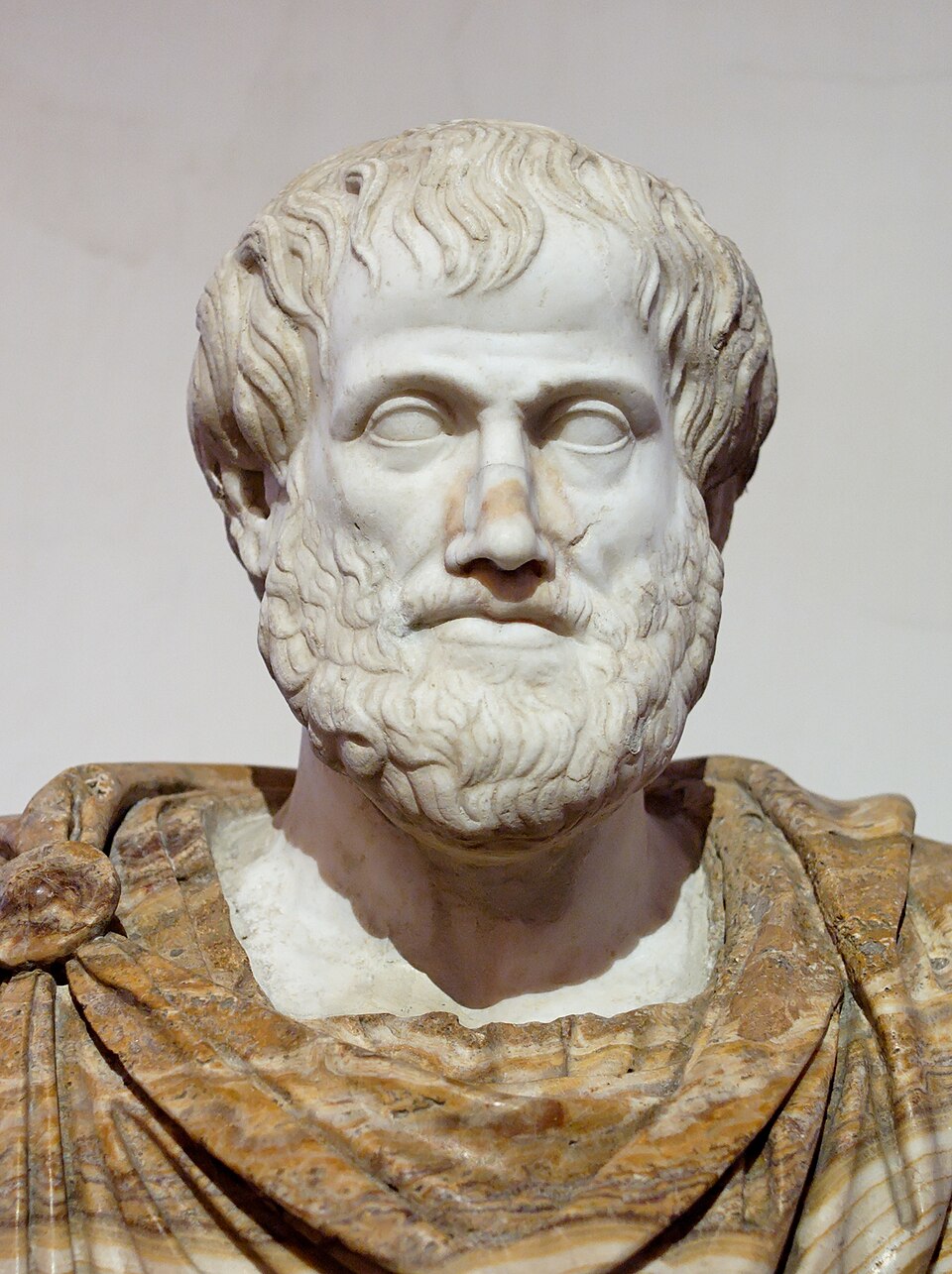
Athens had tried democracy already, and the experiment had a recognizable shape: one in which populist rhetoric, adversarial posturing and money were an easy route to power. One generation earlier, Socrates – Plato’s teacher – had been put to death by the Athenian state for doing nothing more than walking the city and asking its officials and teachers whether they could justify what they believed. Aristotle’s response to the failures of Athenian democracy was radical. He separated pathos – the emotional force of an argument – from logos, its rational structure. The question was no longer who argued most compellingly. It was whether the argument actually held. The system was published in a collection of six works collectively called the Organon – Greek for “the instrument”. It outlines a structured way of thinking that became the standard by which we distinguish general opinion and scientific knowledge.
When Christianity spread through the Roman world, it reached for the Organon to give theology its conceptual scaffolding. The so-called Dark Ages mark the period when his texts were lost to Europe. The works survived in the Islamic world, where they helped to produce a golden age of mathematics, medicine and philosophy. When they returned west, they ignited the Renaissance. By the Middle Ages, Aristotle had become so mythic a figure that both Islamic and Christian scholars had quietly dropped his name: he was simply “the Philosopher”. To disagree with him was not to disagree with a school of thought. It was to disagree with rationality itself.
Yet the Philosopher’s science had been wrong. He had claimed that the Sun revolved around the Earth, but in 1543 Copernicus showed that this was not the case. This result precipitated the Scientific Revolution. Within a century, Kepler, Galileo and Newton entirely replaced our picture of the universe. The Philosopher’s edifice had stood for 2,000 years, then crumbled in the span of a few generations. And this left an important question: how had the Philosopher managed to be so comprehensively right about scientific knowledge, yet so fundamentally wrong in his scientific knowledge?
This question was finally addressed in the late eighteenth century, when Immanuel Kant published the Critique of Pure Reason. We do not find logical structure in nature; rather, our mind imposes structure on our experience; the results are what we call knowledge. It was a Copernican revolution in philosophy that showed Aristotle’s science wrong, as it claimed something objective, but vindicated his logic as reflecting the mind’s own structure in organizing experiences.
This was plausible enough for our knowledge of the physical world. Scientific theories are, after all, attempts to organize experience. Mathematics, the Queen of the Sciences, posed a deeper challenge. Unlike a scientific theory, mathematics seems objective in a way that transcends any particular experience. If the order we find in the world is imposed by us, what are we to make of the fact that two and two makes four whether or not anyone performs the calculation? In extending his philosophy from science to mathematics, Kant transformed an ancient question about logic into a new question about the source of mathematical truth.
The question proved urgent enough to unsettle even mathematicians far from the philosophical tradition, and left an indelible mark on the public imagination. Charles Dodgson, a mathematics lecturer at Oxford, had grown quietly exasperated with the increasingly abstract and symbol-heavy theories spreading through his subject: rigorous in notation, yet strangely unmoored from visible meaning. Under the pen name Lewis Carroll, he wrote satirical stories in which a young girl stumbles into a world full of absurd reasoning.
Today, logicians trace the resolution of that anxiety to 1879, when Gottlob Frege published a slim and almost unreadable pamphlet called the Begriffsschrift – “concept-script”. On Frege’s account, logic was neither the structure of the mind nor the unfolding of reality, nor a generalization from experience, but a relationship between language and truth. After Frege, reasoning could be written down in a notation that made every inferential step mechanical. That is, moving from premisses to conclusions was a matter of shuffling symbols by fixed rules, with no appeal to intuition or insight. It took some time for the idea to be fully absorbed, but when it was, the consequences were tremendous.
For example, sixty years later, a master’s student at Cambridge, Alan Turing, was trying to understand which mathematical truths could be settled by following rules alone. To resolve it, he imagined an imaginary device that did nothing but shuffle symbols on a tape. His insight, combined with the later work of Claude Shannon, built a new machine that could do logic – the computer.
This view of the development of logic is orthodox, but Aristotle’s “Organon” in Old and New Logic, edited by Colin Guthrie King and Venanzio Raspa, complicates the tidy version of the story. The closing volume of a Bloomsbury trilogy on how Aristotle’s logical writings travelled into our present, it is a collection of essays that pushes back on the idea that Frege’s new logic represented a clean rupture with what came before.
The corrective is overdue. The standard narrative treats Aristotle’s logic as a spent force, superseded once Frege mechanized inference. But several of the volume’s contributors show that this gets the history backwards. The most striking case is that of Friedrich Adolf Trendelenburg, the nineteenth-century philosopher who argued that the grammatical structure of natural language encodes real relations in the world, and that these relations, not arbitrary symbols, provide the proper basis for logic. As King’s careful reconstruction shows, Trendelenburg was not defending Aristotle out of piety; he was insisting that logic without a grip on what propositions are about is logic hollowed out. The irony is that Frege, who is supposed to have overthrown this tradition, was doing something remarkably similar: his Begriffsschrift was designed precisely to capture the inferential structure already latent in mathematical language. The rupture, on this reading, is partly an artefact of disciplinary forgetting.
King’s other key contribution is a defence of Heinrich Maier’s 1,000-page study of the Aristotelian syllogistic, which has been gathering dust for more than a century. He argues that Maier was not merely cataloguing inference patterns, but reconstructing the philosophical motivations behind them: why Aristotle framed the syllogism as he did, and what work it was supposed to do. Similarly, Giovanni Bonacina’s essay on Hegel recovers a figure who saw the danger in the direction logic was heading. He observed that his contemporaries thought it worthy to catalogue “one hundred and sixty-seven kinds of cuckoo”, yet dismissed the classification of the forms of inference as beneath philosophy. Strip logic of its connection to what reasoning is for, he warned, and it becomes precisely that: an entomologist pinning specimens to a board.
Not every essay in the volume lands with equal force, and the collection occasionally suffers from the unevenness endemic to edited volumes. But its central provocation is well taken. If the new logic’s great achievement was to show that inference could be mechanized – and it was – then its great temptation has been to suppose that mechanization is all there is. Frege wanted the foundations of arithmetic; Turing wanted to know which problems a machine could solve; Shannon saw that electrical relays could instantiate Boolean algebra. Each was asking a precise question and getting a precise answer. But logic, for Aristotle, was never only about precision. It was an instrument for navigating the kind of reasoning that matters in courts, assemblies and public argument: reasoning where the premisses are contestable, the evidence incomplete and the stakes real.
That wider ambition is what this volume asks us to recover. The request could not be more urgent: there has never been more debate in our public forums, across both politics and science. But these debates increasingly use the kind of rhetoric that Aristotle fought: an LLM produces, in seconds, a subtle argument that is often coherent, but not logically robust; politicians, meanwhile, have returned to the model of the Athenian demagogues, with populist rather than principled proposals. The last time the discipline of the Organon returned to our thinking, it led to the Renaissance. Perhaps it is time again to return such discipline to our way of thinking about the world?